Rowan McAllister on Choosing Cover Art Work and her new release The Priest (Chronicles of the Riftlands #2)

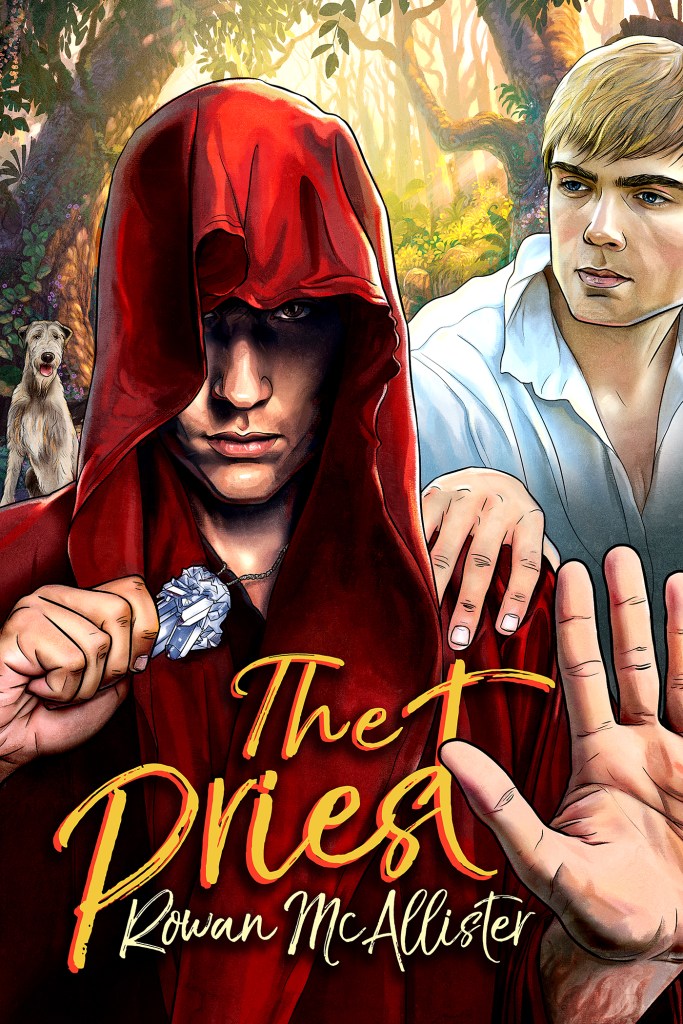
The Priest (Chronicles of the Riftlands #2) by Rowan McAllister

Dreamspinner Press
Published September 10th 2019
Cover Art: Paul Richmond

Buy Links:  Dreamspinner Press | Amazon | Barnes&Noble

Scattered Thoughts and Rogue Words is happy to host Rowan McAllister here today talking about writing, artwork, and her latest story in the Chronicles of the Riftlands series, The Priest. Welcome, Rowan.

✒︎


Hi there!  Thanks for joining me on stop three of my blog tour! And a big thanks to Scattered Thoughts and Rogue Words for hosting.

On this stop, I answer some interview questions that made me smile. I hope they make you smile too.

Ever drunk written a chapter and then read it the next day and still been happy with it?

Funny you should ask, LOL. The answer is, uh, mostly not. As it says in my bio, I’m a bit of a drinkie as well as a foodie. My hubby and I like to experiment with cocktails all the time, so there have been occasions when I’ve done a bit of drunk-writing, but not often. I’ve threatened it more often than I’ve done it. This is because I usually end up fixing most of it so it’s coherent when I’m sober again. But, I will say, a little alcohol can be a useful tool to get me past some of my hang-ups and out of my shell when necessary. I am by nature a reserved person, the product of a family of quiet, contemplative Michiganders- my husband coincidentally is the same way, also the product of Michiganders. A little booze goes a long way to loosening up some of that reserve, since ‘the feels’ is kind of why we’re here. No one wants to read about two people unable to share their feelings for an entire book, or sharing them in the most reserved, polite, and unimposing terms. Jane Austen aside, I think most modern audiences prefer a bit more meat with their potatoes, a bit more passion than a “I really am quite fond of you,” murmured from a respectful distance. When I need to write the passion, a little bourbon and ginger, gin and tonic, or vodka cocktail greases the wheels. But not too much, otherwise what seemed like a masterpiece through bourbon goggles the night before can look like a second-grade book report the next day. And I don’t think day-drinking is a habit I should probably get into. There are other hobbies that are a little easier on my waistline and my liver, because getting old sucks.

How do you choose your covers?

This particular question is timely since I almost had a cover redo for book one in this series so that we could go a different direction with book two’s cover. The scuttlebutt around the internets and the writing world is that drawn covers are out of fashion. Well, honestly, the hard, cold numbers support it too. On average, books with drawn covers don’t sell as well. As much as I love them, it’s hard to argue with numbers.
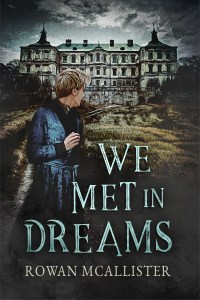
Now, I choose my covers to visually represent the feel of my books. I’m a visual artist of sorts on the side, mostly with fiber, so I definitely have opinions on the ‘look’ I want. I see it as an extension of the book itself. Like for my last historical, “We Met in Dreams”, the story was my deep dive into the over-the-top melodrama of the Victorian Gothic, so obviously, I had to have a gothic novel cover- i.e. our hero running away from a spooky house or castle. I don’t make the rules, people. That’s just how it had to be. Now, I didn’t include the white dress because it didn’t seem appropriate to my hero… but I wanted to.

For book one of the Chronicles of the Riftlands, The Wanderer, I chose a drawn cover because it fit the feel of the book so much better than the more intense, photo-realistic covers that are more popular now. The series is my homage to the fantasy novels of my youth and I still have a deep, abiding love for their quirky and unique drawn covers. I likened it to the animated version of the Hobbit from the 70’s vs the darker, live-action remakes of the 2000’s forward. Each has its appeal but the look of the 70’s version fit the feel of my work better.

But then, there the publisher and I were with the second book… and we all have to make a living. I tried with the newer, flashier concepts- with brooding men in black armor and demons with red eyes photoshopped in front of a desolated, fiery landscape. I really did. But they’re just not my style. Lucky for me, Paul Richmond took pity on me and drew the cover for book two, so I didn’t have to compromise this time. Isn’t it pretty? I may have to bow the pressures of the market someday, you know, to actually sell some books… but today is not that day!

What’s next for you as a writer?

The timing worked out that I’m actually just beginning to write book three of this series right when book two is being released. It helps put me in the mindset to talk about my new release since the juices are flowing in a fantasy direction. Between each chronicle in the series, I’m writing something else to keep my eyes fresh. About a month ago, I submitted a new contemporary for consideration that was a bit more of a struggle than I had originally anticipated and therefore took me much longer to finish than I’d planned. But sometimes the muse will not be tamed, and perhaps it will turn out to be a good thing promoting book two at the same time I’m writing book three after all.
 

The Priest..Chronicles of the Riftlands: Book Two

Brother Tasnerek, one of the infamous Thirty-Six stone bearers, is facing a dangerous crisis of faith after uncovering a secret that could shake the foundations of the Brotherhood of Harot. When Tas is sent to protect a tiny village on the edge of Rassa’s borders from Riftspawn, he struggles to resume his duties, risking his life and the lives of those around him.

Girik has always been an outsider, but to help his sick mother, he agrees to be the village’s offering in a painful ritual deemed necessary by the Brotherhood. But when the priest has a crisis of conscience, Girik offers his help to untangle a web of lies—even if it means getting closer than he ever imagined and committing sacrilege in the process.

With a monster lurking in the forest, a wandering mage mysteriously appearing, and more secrets awakening to unravel the truths of their world, Tas and Girik must make grave decisions. A life without danger seems a far-off hope, but love just might be theirs… if they survive.

About the Author

Rowan McAllister is an unapologetically romantic jack of all trades and a sucker for good food, good cocktails, rich fibers, a great beat, and anything else that indulges the senses. In addition to a continuing love affair with words, she likes to play with textiles, metal, wood, stone, and whatever other interesting scraps of life she can get her hands on. She lives in the woods, on the very edge of suburbia—where civilization drops off and nature takes over—sharing her home with her patient, loving, and grounded husband, three furry rescues, and a whole lot of books, booze, and fabric. Her chosen family is a madcap collection of people as diverse as her interests, all of whom act as her muses in so many ways, and she would be lost without them. Whether her stories have a historical, fantasy, or contemporary setting, they always feature characters who still believe in true love, happy endings, and the oft-underappreciated value of sarcasm.

rowanmcallister10@gmail.com

https://twitter.com/rowanmcallister

https://www.facebook.com/rowanmcallister10

Mason Thomas on Plotter vs Pantser and his new release The Witchstone Amulet (author guest blog)

The Witchstone Amulet by Mason Thomas

Dreamspinner Press
Publication: August 27th 2019

Cover Artist: Tiferet Design

Sales Links:

Dreamspinner Press |   Amazon


Plotter vs. Pantser: That is (not) the question

Summer is what I like to call “con” season.  During these months I go to several different conventions (not least of which is San Diego Comic Con) and my focus, not surprisingly, are the panels with authors and/or about writing. Regardless of who is on the panel or what the intended topic of the conversation is, the discussion invariably centers on process. And every established author has their own distinct, trademarked, approach to writing a novel. Like snowflakes, no two authors tackle the monumental task of novel writing the exact same way.

I love listening to each author discuss their process for that very reason. Every answer is so different. There are commonalities, certainly, but there is clearly not one formulaic approach. Although there are books that provide a structure to novel writing, there really isn’t a one size fits all approach. Every author “eats that elephant” in their own way. And I find great comfort in that.

During these panel discussions, the question “are you a pantser or plotter?” always seems to come from someone in the audience. For those who might not be familiar with these terms, a pantser is the type of writer that flies from the seat of their pants. They let the story unveil itself organically, one scene leading to the next, the author discovering the arc of the story as they write. A plotter is just the opposite. They map out the entire story arc ahead of time and only when they know the beginning middle and end, do they begin to pound out the words.

George R. R. Martin described it similarly as writers come as either gardeners or architects. Perhaps a more artful way of describing the two approaches, but it essentially says the same thing.

The problem with that question is the answer isn’t a binary one. From my experience, it is very rare that an author is either fully one or the other. It is far more likely that an author falls somewhere between the two. The vast majority of authors when pressed will say that they are a hybrid of both. And I fall into that group as well.

Years ago, when asked, I would always hang my hat on the pantser hook. But even then I wasn’t a pure pantser. I had elements of being a plotter as well. Today, the needle is pointing straight up in the middle. I am sitting at the top of the bell curve. I am a panter, or a plotser.

So, I hear you ask, what is my process? What does it look like and how is different from other authors?

It always begins with a nugget of an idea. I can’t tell you where it comes from honestly, but it bubbles up from some corner of my brain and demands my notice, not as a “EUREKA” but a quiet little “huh.” I’ll poke at the idea first, see if it’s worth a closer look, and if it wiggles a bit and giggles back at me, I’ll give it more attention. From there, the idea gets sticky and other ideas start to cling to it, and it expands and expands until I start to envision an arc of a story.

Then, I am compelled to start writing. I let the dog off the leash and let it run. I will pick a scene, something that feels like where the story might start and I’ll just type. Maybe I’ll bite off a chapter, maybe three. But during this time, I’m feeling out who these people are that find themselves on my page, and what the world they inhabit might look like. I allow my subconscious to take over and I’m along for the ride. 

Panster.

But as I settle deeper into the story, I need to make some solid decisions before I can continue. I can’t have characters making life choices if I don’t know the circumstances of their past. And to know those circumstances, I need to know all the various facets of the world that shaped them. So, now I go through the process of world-building and shaping my characters. The world they inhabit is a force that drives their decisions in life, so I need to make sure I understand all the political, economic, and social components. I map out all the character traits, both positive and negative (especially the negatives) and I like to find one dark secret that each character harbors that no one else knows.

I start to envision their journey and begin to map out where I see them going and where they will end up at the end of it all.

Plotter.

Now, it’s a game of leapfrog. When I write scenes, furthering the story, their actions and interactions unveil more of the big picture that I didn’t—or couldn’t—predict. There are nuances and happy discoveries that only come to light when you are immersed in a scene. I always say if I’m surprised my readers will be too, so I embrace this part of it.  But along with the wild reveal of the plot, it requires going back and adding these unearthed details to the character backstories and to the world, because those new discoveries will affect the further trajectory of the story. This then dictates what future scenes are necessary to continue to propel the story forward. Each of these feeds the other.

Ergo, plotser.

By the end, my first draft, surprisingly, has about the same word count that the final revised version will have. This is after I’ve deleted the chaff and added more scenes that flesh out and round out the plot.

There it is: my process. It’s not pretty, and it’s not refined. It’s a mad, chaotic scramble that often feels more like a frantic excavation than writing a novel. Michelangelo is quoted as saying that he was only revealing the work that was trapped in the stone, and in a strange way I understand that thinking. The true nature of the story reveals itself to me and I am on some level powerless against it.

One important point to add regarding my process, however. I need to know how the story is going to end—at least generally. I may not know the route, but at least I need to know the destination.

In my view, the reason the question of plotter vs. Pantser is so frequently asked is people are looking for guidance as to how to best tackle that monumental task of writing a novel. But the important take-away in all this is there is no singular approach, no right way and no wrong way. Every writer approaches it differently. The only way to know what is right for you is sit down and discover it for yourself. 

Blurb for THE WITCHSTONE AMULET


Protect it at all costs.


That’s what rugby player Hunter Best’s mother told him before she died. But when Hunter surprises an intruder in his Chicago apartment, he discovers her amulet stolen. Hunter pursues the thief—all the way through a strange vortex. He wakes in a bizarre and violent world, a benighted realm on the threshold of civil war.


The queen has become a ruthless tyrant, punishing any who oppose her, weakening the kingdom’s defenses against the brutal Henerans. To survive, Hunter must depend on the man who robbed him, a handsome former spy named Dax, now a leader of the resistance that believes the queen is an imposter–a Heneran disguised by magic… who also looks identical to Hunter’s mother.


There’s no love lost between Hunter and Dax, and even if Hunter grudgingly agrees with the resistance, he just wants to reclaim his property and go home. But he might be the only one who can oppose the queen and end her reign of terror.


Mason Thomas Bio

Mason Thomas began his writing journey at the age of thirteen when his personal hero, Isaac Asimov, took the time to respond to a letter he wrote him. He’s been writing stories every since. Today, he is ecstatic and grateful that there is a place at the speculative table for stories with strong gay protagonists. Mason, by all accounts, is still a nerdy teenager, although his hairline and waistline  indicate otherwise. When his fingers are not pounding furiously at a keyboard, they can usually be found holding a video game controller, plucking away at an electric guitar, or shaking a twenty-sided die during a role playing game. Mason will take any opportunity to play dress up, whether through cosplay, Halloween or a visit to a Renaissance Faire. He pays the bills by daring middle school students to actually like school and encouraging them to make a mess in his science classroom. He lives in Chicago with his endlessly patient husband, who has tolerated his geeky nonsense for two decades, and their two unruly cats who graciously allow Mason and his husband to share the same space with them.