Available for Purchase from
Scattered Thoughts and Rogue Words is happy to have Mason Thomas here today to talk about writing, characters and his latest release, The Shadow Mark. Welcome, Mason.
~
~Scattered Thoughts and Rogue Words Interviews Mason Thomas~
How much of yourself goes into a character?
An intriguing question, and the answer isn’t easy to peg down since character development doesn’t always occur on a conscious level. It’s impossible to not put yourself into your characters to some extent since it is your own experiences that you draw from. You cannot escape your own brain, and little aspects of yourself are going to infiltrate your characters. None of my characters are ever “me” per se. They just tap into various facets of my personality.
At times, you need to be deliberate about it. To generate authentic reactions to the events in your story, you have to draw from your personal experiences and extrapolate what the feelings and responses would be. Auraq Greystone, the main character in The Shadow Mark, is the least like me in terms of personality. He’s brooding and ill-tempered, and isn’t into talking about his feelings. This made him a challenge to write—in a good way. I had to dig deep into some dark history at times to channel him properly.
I will say there are times however that a character comes onto the scene and I have no idea where he or she came from. They arrive fully formed and announce who they are with utter certainty. It’s as if they’ve already received an early draft and are merely showing up to perform their part, and I’m only there to record them in the scene. I’ve even tried to direct them, and say, no I’d like you to be more “this.” They grin back at me, and then do what they’re going to do anyway, whether I like it or not.
Do you feel there’s a tight line between Mary Sue or should I say Gary Stu and using your own experiences to create a character?
You have to be mindful of that line, certainly. I’m very intentional when creating a character not use myself as a template. Like I said in the previous question, you can’t escape your thoughts and your own experiences, but characters also take on their own distinct traits and personalities through the writing process. They evolve their own identities, and you cannot fight against that. You are not the character—you are only channeling them, recording their words and actions.
You also have to embrace the weaknesses and negative qualities of your characters. It’s good if your main character makes a mistake, or says the wrong thing, or makes a mess of something. Readers have to see that a character can fail. There’s a looming fear that bad behavior will make your character unlikeable, but what it can do is makes them believable—and if the reason behind the bad behavior fits their history or circumstances, it makes them sympathetic too.
Does research play a role into choosing which genre you write? Do you enjoy research or prefer making up your worlds and cultures?
I enjoy the world building aspect of writing speculative fiction. I like the “sandbox” nature of being able to construct the world and establish the rules that exist within it. I pull from real world events, cultures and experiences, but since the world is of your own design, there isn’t a danger of getting the facts wrong. You just have to make certain that your world make sense, and you don’t break your own rules. This means that much my research is for generating ideas.
Sadly, I cannot escape real research, however. Do I enjoy it? No. But it’s a necessary evil. Smaller details—like how a barrel is constructed, or how a mill works to grind flour—have to be right. A detail you’ve gotten wrong is an insipid little imp that can easily escape your notice if you’re not careful, and it can turn your reader against you if they catch it. Combat is the area that I probably invested the most time researching a topic. I’ve even taken longsword classes to learn how to move, and how the body feels and reacts during combat. That was my favorite kind of research. If you’ve never taken a sword-fighting class, it’s seriously fun and I recommend it for everyone.
Has your choice of childhood or teenage reading genres carried into your own choices for writing?
The irony is I wasn’t always a great reader as a kid. I have a slow reading speed, and being ADHD, I had a difficult time remaining focused long enough on a book to finish it. I lost interest very easily. The very first novel I read on my own from cover to cover was The Hobbit. I was in sixth grade. I was instantly hooked. Something about the escapism of fantasy (and science fiction as well) and the notion of a completely different world, connected with my overactive brain and dynamic inner life like nothing ever had before. I’ve been obsessed with speculative fiction ever since.
Today, I write the stories I wish had existed when I was growing up—fantasy adventures with gay heroes.
Have you ever had to put an ‘in progress’ story aside because of the emotional ties with it? You were hurting with the characters or didn’t know how to proceed?
More the opposite. I use my own emotional connection to a story as a barometer. If I’m not feeling emotional as I write it, then it’s not connecting for some reason and I have to shelf it until I figure out what it’s missing. I’ve not yet reached a topic that cut too deeply, as it were, that it forced me to put it aside.
Do you like HFN or HEA? And why?
This entirely depends on the story being told and the characters that occupy it.
Do you read romances, as a teenager and as an adult?
I tend to not pick up novels that identify as “romance” alone. I choose the ones that overlap into speculative fiction. For me, as both a writer and a reader, I like it when the love story exists along with a larger context, and the two work in concert. The speculative elements shouldn’t be just a backdrop for the romance, but play a part in bringing the people together. And speculative stories without a romance feel incomplete. The romance brings an authenticity to the story because connecting with others is a part of life that shouldn’t be ignored.
Who do you think is your major influence as a writer? Now and growing up?
Hard to narrow this one down. I’ve been influenced by so many amazing writers over the years. Tolkien, of course, since he was my first introduction to speculative fiction. Anne McCaffrey, Brain Jacques, Piers Anthony and Stephen King to name a few more. Each of these authors has a magic about them that I’ve always revered—the ability to pull me so completely into their world. However, my primary influence as a writer has been Isaac Asimov, a writer from the golden age of science fiction. He was incredibly prolific, writing five-hundred books in his lifetime—but still took the time to type a personalized note to a thirteen-year-old fan boy who wrote him a letter with a pointless and annoying question. Twice. I’ve always thought that was incredibly gracious of him. I have always been drawn to his intellect, and his humor, and his devotion to his craft. Many of his quotes are on my favorites list, but one quote has had a great impact on me as a writer: “I made up my mind long ago to follow one cardinal rule in all my writing—to be clear.”
How do you choose your covers? (curious on my part)
Choosing a cover is terribly difficult and stressful for me. I want it to emote the tone of the book, I want it to be visually striking, and I want it to be sexy. I also want it to be original and stand out. That’s a lot of boxes I need it check off. I perseverate on the tiniest details, because once I’ve chosen the cover, it is forever connected to that work. I’m sure I drive the artist a little insane. Can you change the font? Can you move my name up just a little? Can you bring a little more color into it? I applaud their patience.
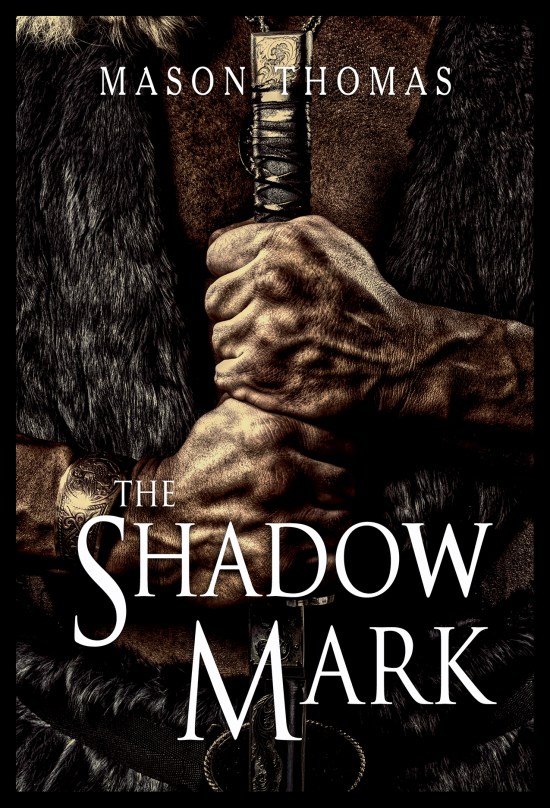
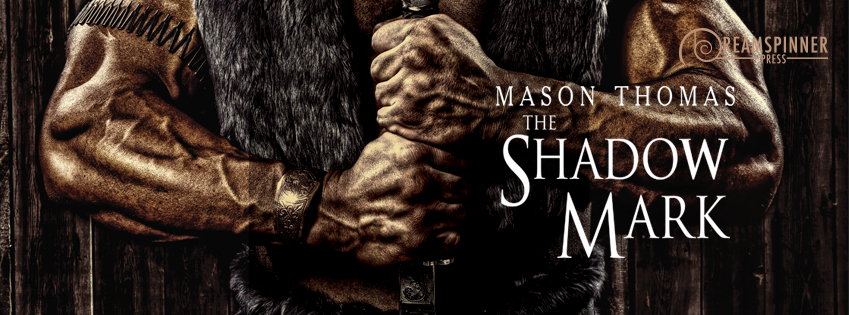
The cover of The Shadow Mark, which was designed by Maria Fanning, is astounding and I couldn’t be happier with the result. It has everything I wanted. I think it exudes the strength of my main character, Auraq Greystone, it has a compelling look that draws you in, and it connects well to my previous cover as well.
Do you have a favorite among your own stories? And why?
Short answer—no. They are all deeply personal to me for different reasons, and to select one over another is impossible. If I’m not fully drawn in to my own story, I’m not compelled to write it and it doesn’t get finished. My favorite project tends to be the one I’m currently working on.
What’s next for you as an author?
Juggling quite a few projects right now. I’ve recently finished a new young adult fantasy novel that I’ve very excited about. It’s the first in what I hope to be a series, with multiple young LGBTQ characters. My goal for this was to create a world where the LGBTQ characters are admired and respected, and are the heroes of the kingdom. I’m in the process of editing it now, and hope to send it out this summer. I’m writing another romance/fantasy that takes place in a different world than the Lords of Davenia series. I’m also in the planning stages of creating a sequel for Lord Mouse.
Blurb
Auraq Greystone, once a military officer with a promising future, exists on the fringe of society. Accused of murder, Auraq is on the run from the ax—until two fugitives crash into his solitary life. One is a young man named Kane. The glowing marks on his arm pulse with an otherworldly power, and they have made him the target of a sinister organization called the Order of the Jackal. When the old man protecting Kane dies in an ambush, Auraq swears an oath to take his place.
But the runes are far more significant than they realize. They are a message from the shadow realm, a dark memory of the past—one holding evidence of a bloody massacre and its savage architect; one that will shake the kingdom to its foundation. Risking arrest and execution, Auraq fights to get Kane to the capital city where the cryptic marking can be unlocked. And with assassins close on their trail, Auraq might never get the chance to show Kane what’s in his heart—or the way their journey together has changed him.
The Shadow Mark is an epic tale of magic, murder, conspiracy, betrayal, and—for the two men tasked with unraveling the mystery—love and redemption.
Mason Thomas AUTHOR BIO:
Mason Thomas began his writing journey at the age of thirteen when his personal hero, Isaac Asimov, took the time to respond to a letter he wrote him. He’s been writing stories ever since. Today he is ecstatic and grateful that there is a place at the speculative table for stories with strong gay protagonists.
Mason, by all accounts, is still a nerdy teenager, although his hairline and waistline indicate otherwise. When his fingers are not pounding furiously at a keyboard, they can usually be found holding a video-game controller, plucking away at an electric guitar, or shaking a twenty-sided die during a role-playing game. Mason will take any opportunity to play dress-up, whether through cosplay, Halloween, or a visit to a Renaissance Faire. He pays the bills by daring middle school students to actually like school and encouraging them to make a mess in his science classroom. He lives in Chicago with his endlessly patient husband, who has tolerated his geeky nonsense for nearly two decades, and two unruly cats who graciously allow Mason and his husband to share the same space with them.
Social Media Info

 What helps makes this successful for me is that Hunter is well established as a character, and the reader is immersed in his POV, before anything extraordinary happens. Hunter’s choices, based on who he is as a person, lead him to another realm after he follows a thief stealing his mother’s brooch. This is a typical portal story of moving between worlds, but it’s very well written. Thrown into action in the enemy territory of the Heneran lands, a tense truce is formed between Hunter and the thief Dax as they try to survive. Once they are near out of enemy territory, Hunter meets the Rebellion forces–a ragtag band of people living in a camp in the wilderness and gets thrown into politics against the Crown. As the setting shifts to the capital city of Andreya, he learns more about his new world and how to survive in it. His world crumbles as he starts to question everything he thought he knew, including about his own mother. I felt like I was getting pulled in and figuring things out more quickly than Hunter, which is a clever way of getting the reader invested.





 Scattered Thoughts and Rogue Words