Review: Demolished by Astrid Amara

Rating:  4 stars out of 5

DemolishedWhen Calvin Quarry meets up with his anonymous hookup, he is startled and upset to find out that the man is none other than Felix Bracks.  Felix Bracks was responsible for the death of Calvin’s closest friend in high school and several of their classmates.  Calvin flees from the encounter, horrified.  But Felix pursues him, calling and texting Calvin over the next week or so.  Felix wants Calvin to hear his side of the story.  While it’s not something Calvin wants to hear, eventually he gives in and listens to a version of the story that differs greatly from the one he knew.

Felix Bracks has spent years as a social outcast because of that accident in high school.  Physically and emotionally scarred, he thought he had recovered.  But feeling the distain and hate from Calvin after all these years, hurts him.  He is attracted to Calvin and wants the man to like him.  But Felix only tells Calvin part of the truth, keeping the full story to himself.

When Calvin’s cousin Robbie gets involved in something sinister, something that is derailing his life, Calvin decides to investigate.  After all Calvin is an journalism major, this is something he knows how to do.  But as Robbie falls deeper and deeper into trouble, Calvin’s investigation starts to lead him not only to Robbie’s problem but Felix’s past as well.  As the past starts to intrude on Calvin and Felix’s relationship, will they be able to trust each other or will the revelations from the past demolish the love they have found with each other?

Astrid Amara is an automatic go to author for me.  I love her stories, especially her holidays with The Bellskis which rank among my favorite.  So when I heard she had a new story coming out, I was thrilled.  Demolished has all the elements I have come to expect from this author.  Great characters and an mystery that involves the reader emotionally as well as mentally.

Amara starts us off with Calvin agreeing to meet his online hookup, Bikenut, in person for some hot, and decidedly casual sex.

After four weeks of online flirtations and cybersex, Calvin Quarry finally got up the nerve to meet Bikenut in person.

Meet wasn’t the correct term. Screw worked better. Bikenut agreed to host. Cal would knock on the man’s apartment door five times, walk in, and he would be grabbed and taken aggressively and quickly. Then he’d depart.

It was the kind of online hookup Cal always dreamed of engaging in but never had the nerve to. But after weeks of conversations online with the guy with the username Bikenut, a series of photographs showing the man’s impressive endowments, and the guy’s general sense of good humor and intelligence, Cal gave in to his fantasies and arranged the meeting.

But from the moment, Calvin and his online buddy meet face to face, everything starts to go wrong.  Because Bikenut turns out to be Felix Brachs, the boy Calvin and his community love to hate.  Felix was involved in a car accident turned fatal for several high school students, including Calvin’s best friend and secret crush.  For that alone Calvin has hated Felix all these years.  Amara does a wonderful job in making Calvin and then Felix, open and appealing young men.  We understand the emotions each person is feeling and can relate to each of them, easily seeing that horrendous event from both sides of the story.  As created by Amara, these are earnest young men with their futures ahead of them.  But both Calvin and Felix have a joined past that they need to put behind them before they can go forward.  The author’s characterizations give Calvin and Felix each a layer of vulnerability that goes hand in hand with their youthfulness.  Each has experienced past angst and trauma, from the devastation of the accident to their coming out as gay youths.  And in every scene, Astrid Amara makes us feel their pain and confusion with a vividness that is heartbreaking.

Robbie is another wonderfully engaging character.  Younger than Calvin and Felix, Robbie is in trouble.  His grades have fallen, he is sullen and keeping secrets.  All the hallmarks of drug and alcohol abuse.  Robbie’s situation becomes increasingly grave over the course of the story and the reader’s anxiety over Robbie’s future deepens as clues from the past intertwine with revelations about Robbie’s current predicament.  For me, this is where Amara really shined.  Amara’s portrait of Robbie, a youth in trouble,  is  both realistic and grim and handled with sensitivity.  The author ticks off the boxes of the parental check sheet of things to look out for to see if a child is in trouble.  But she incorporates that knowledge seamlessly into Robbie’s personality and behavioral changes noticed by Calvin and Robbie’s parents.   We watch it happening, we see the missteps by Calvin that we know can be laid at his youthfulness and inexperience, and the dread just seeps into the reader, spreading over the story as we wait to see how it will all play out.

I have a few quibbles with Demolished.  The first of which I am not sure really mattered in the end.   Perhaps I have watched far too many police procedurals on cable, but I could see some of the plot twists and turns coming, including the biggest of them all.   That said, the journey to  that point was so suspenseful and thrilling it didn’t matter so much that I knew where we were headed to begin with.  The other quibble was the almost instantaneous love that sprang between a young man with hatred in his heart and the object of his distain.  I wondered if Calvin could really push all those carefully hoarded feelings away and fall in love almost immediately with Felix.  Maybe or then again, maybe not.  That was a harder bump in the road to get over.   But once I accepted their relationship, the story moved forward quickly, attaching my feelings in the process.

If you are new to Astrid Amara, there are so many books out there for you to start with.  Whether it is the science fiction of Hell Cop,  the contemporary holiday romance of The Carol of the Bellskis, or the mystery romance of Demolished, you can’t go wrong.   Start here and work your way through her backlist.  Astrid Amara lives in Bellingham, Washington, the wildly quirky town that is home to another one of my favorite authors, Nicole Kimberling.  I have never been to Bellingham but feel a road trip coming on.  What a place it must be to have such wonderful authors residing there and writing such amazing stories.  No matter, Astrid Amara is a terrific author. Begin your journey with her here.

Cover artist, Valerie Tibbs, has created a terrific cover for Demolished, the red is the perfect color in tone and emotion for the story within.

Book Details:

ebook, 165 pages
Published July 16th 2013 by Loose-ID
ISBN13 9781623004156
edition language English

Martin Luther King, Jr., I Had A Dream speech, and This Coming Week In Reviews

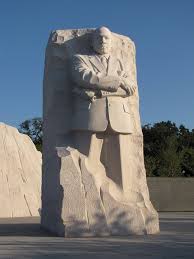
MLK on the MallIt’s the 50th anniversary of Martin Luther King’s speech on Wednesday and yesterday tens of thousands of people gathered to commemorate that momentous occassion and to remind  the world that his dream still needs to be fulfilled.   Racism still exists and we as a nation still have such a long way to go for all to be equal under the law and in each other’s eyes.

Just in time for his anniversary, the MLK statue on the memorial was “fixed” so that awful truncated version of MLK’s speech is now gone,  That was just another example of how this man and his message is still misunderstood by some, in this case the Chinese artist and a group of architects responsible for that statue..   IMLK statue am not a fan of that statue.  To me it belongs in Tiananmen Square not Washington DC, it exemplifying the type of statuary so often seen in the communist nations.  Where is the man of passion?  Where is the man of fire and vision?  I don’t see him in the statue but instead look to his speeches where he and his dream will live forever.

Martin Luther King’s “I Had A Dream” speech:

I am happy to join with you today in what will go down in history as the greatest demonstration for freedom in the history of our nation.

Five score years ago, a great American, in whose symbolic shadow we stand today, signed the Emancipation Proclamation. This momentous decree came as a great beacon light of hope to millions of Negro slaves who had been seared in the flames of withering injustice. It came as a joyous daybreak to end the long night of their captivity.

But one hundred years later, the Negro still is not free. One hundred years later, the life of the Negro is still sadly crippled by the manacles of segregation and the chains of discrimination. One hundred years later, the Negro lives on a lonely island of poverty in the midst of a vast ocean of material prosperity. One hundred years later, the Negro is still languishing in the corners of American society and finds himself an exile in his own land. So we have come here today to dramatize a shameful condition.

In a sense we have come to our nation’s capital to cash a check. When the architects of our republic wrote the magnificent words of the Constitution and the Declaration of Independence, they were signing a promissory note to which every American was to fall heir. This note was a promise that all men, yes, black men as well as white men, would be guaranteed the unalienable rights of life, liberty, and the pursuit of happiness.

It is obvious today that America has defaulted on this promissory note insofar as her citizens of color are concerned. Instead of honoring this sacred obligation, America has given the Negro people a bad check, a check which has come back marked “insufficient funds.” But we refuse to believe that the bank of justice is bankrupt. We refuse to believe that there are insufficient funds in the great vaults of opportunity of this nation. So we have come to cash this check — a check that will give us upon demand the riches of freedom and the security of justice. We have also come to this hallowed spot to remind America of the fierce urgency of now. This is no time to engage in the luxury of cooling off or to take the tranquilizing drug of gradualism. Now is the time to make real the promises of democracy. Now is the time to rise from the dark and desolate valley of segregation to the sunlit path of racial justice. Now is the time to lift our nation from the quick sands of racial injustice to the solid rock of brotherhood. Now is the time to make justice a reality for all of God’s children.
It would be fatal for the nation to overlook the urgency of the moment. This sweltering summer of the Negro’s legitimate discontent will not pass until there is an invigorating autumn of freedom and equality. Nineteen sixty-three is not an end, but a beginning. Those who hope that the Negro needed to blow off steam and will now be content will have a rude awakening if the nation returns to business as usual. There will be neither rest nor tranquility in America until the Negro is granted his citizenship rights. The whirlwinds of revolt will continue to shake the foundations of our nation until the bright day of justice emerges.

But there is something that I must say to my people who stand on the warm threshold which leads into the palace of justice. In the process of gaining our rightful place we must not be guilty of wrongful deeds. Let us not seek to satisfy our thirst for freedom by drinking from the cup of bitterness and hatred.

We must forever conduct our struggle on the high plane of dignity and discipline. We must not allow our creative protest to degenerate into physical violence. Again and again we must rise to the majestic heights of meeting physical force with soul force. The marvelous new militancy which has engulfed the Negro community must not lead us to a distrust of all white people, for many of our white brothers, as evidenced by their presence here today, have come to realize that their destiny is tied up with our destiny. They have come to realize that their freedom is inextricably bound to our freedom. We cannot walk alone.

As we walk, we must make the pledge that we shall always march ahead. We cannot turn back. There are those who are asking the devotees of civil rights, “When will you be satisfied?” We can never be satisfied as long as the Negro is the victim of the unspeakable horrors of police brutality. We can never be satisfied, as long as our bodies, heavy with the fatigue of travel, cannot gain lodging in the motels of the highways and the hotels of the cities. We cannot be satisfied as long as the Negro’s basic mobility is from a smaller ghetto to a larger one. We can never be satisfied as long as our children are stripped of their selfhood and robbed of their dignity by signs stating “For Whites Only”. We cannot be satisfied as long as a Negro in Mississippi cannot vote and a Negro in New York believes he has nothing for which to vote. No, no, we are not satisfied, and we will not be satisfied until justice rolls down like waters and righteousness like a mighty stream.

I am not unmindful that some of you have come here out of great trials and tribulations. Some of you have come fresh from narrow jail cells. Some of you have come from areas where your quest for freedom left you battered by the storms of persecution and staggered by the winds of police brutality. You have been the veterans of creative suffering. Continue to work with the faith that unearned suffering is redemptive.

Go back to Mississippi, go back to Alabama, go back to South Carolina, go back to Georgia, go back to Louisiana, go back to the slums and ghettos of our northern cities, knowing that somehow this situation can and will be changed. Let us not wallow in the valley of despair.

I say to you today, my friends, so even though we face the difficulties of today and tomorrow, I still have a dream. It is a dream deeply rooted in the American dream.

I have a dream that one day this nation will rise up and live out the true meaning of its creed: “We hold these truths to be self-evident: that all men are created equal.”

I have a dream that one day on the red hills of Georgia the sons of former slaves and the sons of former slave owners will be able to sit down together at the table of brotherhood.

I have a dream that one day even the state of Mississippi, a state sweltering with the heat of injustice, sweltering with the heat of oppression, will be transformed into an oasis of freedom and justice.

I have a dream that my four little children will one day live in a nation where they will not be judged by the color of their skin but by the content of their character.

I have a dream today.

I have a dream that one day, down in Alabama, with its vicious racists, with its governor having his lips dripping with the words of interposition and nullification; one day right there in Alabama, little black boys and black girls will be able to join hands with little white boys and white girls as sisters and brothers.

I have a dream today.

I have a dream that one day every valley shall be exalted, every hill and mountain shall be made low, the rough places will be made plain, and the crooked places will be made straight, and the glory of the Lord shall be revealed, and all flesh shall see it together.

This is our hope. This is the faith that I go back to the South with. With this faith we will be able to hew out of the mountain of despair a stone of hope. With this faith we will be able to transform the jangling discords of our nation into a beautiful symphony of brotherhood. With this faith we will be able to work together, to pray together, to struggle together, to go to jail together, to stand up for freedom together, knowing that we will be free one day.

This will be the day when all of God’s children will be able to sing with a new meaning, “My country, ’tis of thee, sweet land of liberty, of thee I sing. Land where my fathers died, land of the pilgrim’s pride, from every mountainside, let freedom ring.”

And if America is to be a great nation this must become true. So let freedom ring from the prodigious hilltops of New Hampshire. Let freedom ring from the mighty mountains of New York. Let freedom ring from the heightening Alleghenies of Pennsylvania!

Let freedom ring from the snowcapped Rockies of Colorado!

Let freedom ring from the curvaceous slopes of California!

But not only that; let freedom ring from Stone Mountain of Georgia!

Let freedom ring from Lookout Mountain of Tennessee!

Let freedom ring from every hill and molehill of Mississippi. From every mountainside, let freedom ring.

And when this happens, when we allow freedom to ring, when we let it ring from every village and every hamlet, from every state and every city, we will be able to speed up that day when all of God’s children, black men and white men, Jews and Gentiles, Protestants and Catholics, will be able to join hands and sing in the words of the old Negro spiritual, “Free at last! free at last! thank God Almighty, we are free at last!”

Now to the week ahead in book reviews.  I have the second series from the Pulp Friction authors and a guest blog from Lee Brazil this week.  I love these series and can’t wait to bring the third one to you the week after next.  That will be the Triple Threat series by Laura Harner.  I also have two books by authors who are always on my TBR list, Astrid Amara and Josephine Myles.  Be sure to grab those up as well.

The weather is exquisite.  Present are those clear blue early autumn skies that make you smile and stay outside until twilight falls.  I heard my first flock of snow geese go trumpeting overhead last night, the first of many that signal an early fall.  The whitetail deer herds are also reforming early.  That would account for the over 15 of them in my neighbors yards last night.  Did it make the terrors three crazy?  Why, yes it did!  As well as every other dog in the neighborhood.  Almost time to start winter proofing my gardens but not just yet.  I will enjoy them for a little longer.  So its time to gather up my Kindle and my knitting (and of course the dogs) and head outside to enjoy the day.   I hope you will enjoy yours too.

Monday, Aug. 26, 2013:                     Fifty Fifty Chances Are by Lee Brazil

Tuesday, Aug. 27, 2013:                     Ghost of Chances Are by Lee Brazil

Wed., Aug. 28, 2013:                            Author Spotlight: Meet Lee Brazil

Thurs., Aug 29, 2013:                           Demolished by Astrid Amara

Friday, Aug. 30, 2013:                         Handle With Care by Josephine Myles

Sat., Aug. 31, 2013:                              A Summary of Scattered Thoughts August Reviews