Wild Onions Guest Blog with Author Sarah Black

Scattered Thoughts and Rogue Words is welcoming Sarah Black this week to talk about her latest two releases Wild Onions and The General and the Elephant Clock of Al-Jazari.  In today’s post, the author talks about her love for Idaho, the setting for Wild Onions.

During this four day Sarah Black event, we will be giving away one copy of The General and the Elephant Clock of Al-Jazari to one lucky person who comments on any Sarah Black blog from10/22 to 10/26 with the winner to be announced on Saturday.   Visit

Leave a comment below.

Falling in Love with Idaho: An Illustrated Adventure by Sarah Black

A few years ago, on one of my periodic urges to explore the world, I took a locum job as the Nurse Practitioner at a small clinic in an Athabascan village in Alaska. The village was on the Yukon, about 130 air miles from Fairbanks. We moved in February, and all I will say about that is if you are going to move to Alaska, consider waiting until the summer. On the positive side, my son got to experience the joy of having his boogers freeze at forty below zero, which is the sort of thing boys love and moms will never understand.

In July, I bought a truck in Fairbanks and we left, (I might say ‘fled’ if I was being very honest) driving back to America on the ALCAN Highway. Since I had no intention of ever returning to Alaska, we took the opportunity to visit the National Parks. It is my avowed intention of visiting all of America’s National Parks in my lifetime. Except the Everglades, because I missed my chance and I’m not going back to Florida. That story for another time.

Here’s my baby on our first trip to the North Rim of the Grand Canyon, my favorite of the National Parks, wearing my college sweatshirt!SB -James at North Run Grand Canyon
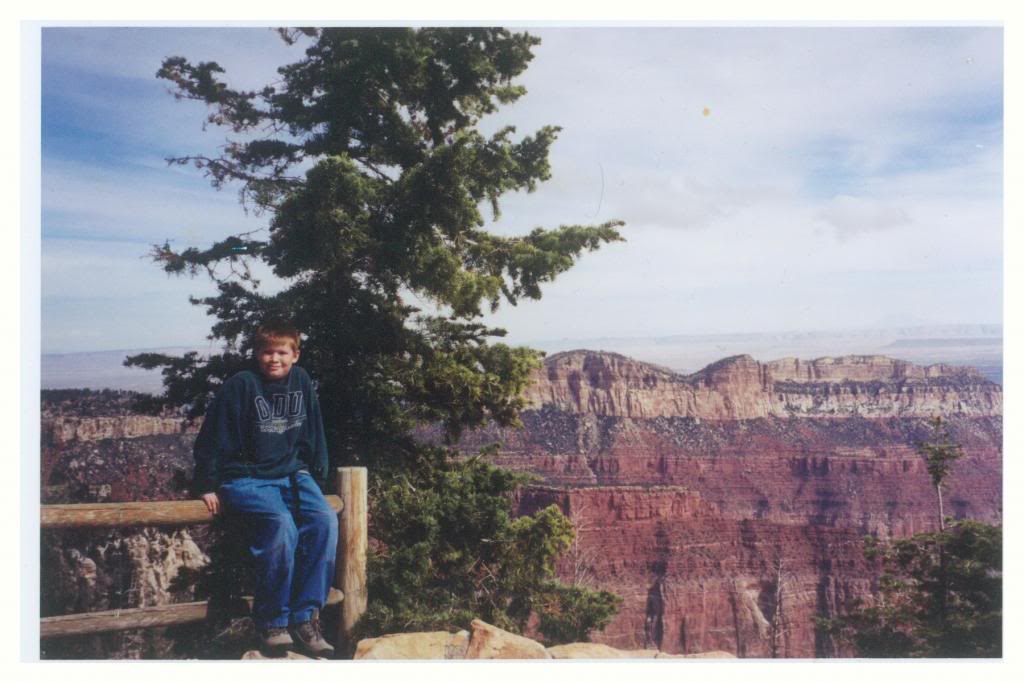
Anyway, we had a very good time visiting gorgeous Denali and Kenai and Katmai and staring a glacier in the face; I couldn’t help but wonder if they would still be around in another fifty years. The scenery was gorgeous, but we didn’t see any wildlife. My only near miss with a bear was actually a hiker, sleeping in the grass, who popped up so suddenly I thought he was a bear and I nearly keeled over in shock. Also a flasher at the Grizzly Café outside Denali who looked like Santa, but I’m not sure if he was an intentional flasher, or if he just forgot both his underwear and zipper. Either way I classified him as wildlife.

One of the glaciers in Kenai Fjords:
SB Alaska Glacier 2
After Flasher-Santa, I said, screw it, let’s head to Canada. Almost as soon as we crossed the border, we found all the wildlife. I don’t know why the eagles and bears and wolves were in Canada- perhaps the IRS turned their eye on them and they sought asylum? Either way, we drove slowly, and the bears ambled across the road, babies bouncing behind, and my kid stared at them out the window and said, ‘they look just like they do in the pictures!’ And that was my exact thought as well.SB JamesGlacierNatnPark002_zps00698238

We crossed the border with the US at Glacier National Park in Montana, and immediately had a lecture about bear safety. I tried to tell the Ranger the bears were all up in Canada, but he doubted my theory about the wildlife moving north. My son adores Park Rangers and always has many questions for them.

He takes their rules, usually posted near the bathrooms, for gospel and we always follow the safety rules to the letter. Which is why we had our toothbrushes in plastic bags, and locked in the truck. Because bears can smell Crest. We ate our hotdogs and marshmallows and then lay in a very small tent, and SB Glacier Park with boatsI stayed awake all night, listening for the grunt and rasp of ursine breathing through very thin nylon. The bighorn sheep were crawling all over the mountains, the lakes and rivers were icy cold, and we experienced the terror and delight of Going to the Sun Road.

After all this fun, I told the kid we needed to head on to Boise, where I had received a job offer. Frankly I was exhausted by all the adventure.

So we started driving through Montana, heading to Idaho.

The Northern Rockies are like nothing I’d even seen before. Huge, stark, forbidding, but sort of protective, too. The valleys were encircled, and the mountains were big andSB Northern Rockies strong, and I was safe there, safe surrounded by these old grandfathers. It was a

strange feeling. I was used to being the tough one, strong myself, taking care of everyone, and in these mountains, I felt like they were watching out for me. I was astounded. Astounded and so relieved I felt like weeping.

The rivers are not like the rivers I’d grown up with back east. These rivers are noisy, muscular, tumbling and roaring. Idaho has a masculine spirit, the landscape strong and tough and silent as a cowboy. No wonder I fell in love! And the people are like the landscape—tough and still, very strong, but with hearts as big as the mountains.

SB Salmon River #6

These are the Grand Tetons. The French fur trappers in the mountains called them Les Tois Tetons, which means, of course, The Three Breasts. What did I say about the masculine spirit? Some historians suggest the mountains were named for the Teton Sioux. There were many Native tribes in this area, Bannock, Arapahoe, Cheyenne, Sioux, Blackfoot. I used the past tense just then, but small groups of Bannock and Arapahoe still live in these mountains. I’ve always been fond of the Blackfoot, since they were the only tribe to try and ambush Louis and Clark.

SB Grand Tetons
When I first moved out to Navajo country to work, I took my usual view of the world, and since I like to listen to people talk, found myself hearing really different perspectives on things. I worked at a tribal boarding school, and I heard a couple of the teachers talking about what they were going to do to teach Lewis and Clark’s trip west. One of the teachers just shook his head, said, “Those bastards.”SB Idaho Lewis and Clark Trail
I’ve always been a bit of a Corps of Discovery nerd. This was the first time I’d heard an opinion from the other side! This is just off of the Lewis and Clark Trail through the Northern Rockies.

Buy Link to Wild Onions:HERE IT IS!

Review of Wild Onions
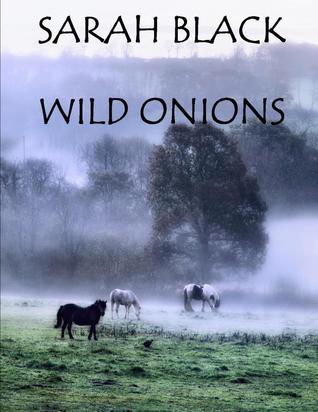
Review: Wild Onions by Sarah Black

Rating: 5 stars out of 5

Wild Onions coverStill healing from his many injuries,  both physical and emotional, photographer Robert Mitchell has returned to the cabin he shared with his partner Val to grieve over Val’s death and determine whether he should sell it or hold onto the place full of memories and ghosts.  Just over a year ago, Robert’s life was happy and full.  He had his work, and his long time lover.  And then it was gone. With a mountain of debt looming over him from their hospital bills, Robert is unsure of his future but he still  can’t let go of his past, seeing and hearing Val’s ghost everywhere. Then Robert meets a young Blackfoot indian fly fishing in the Salmon River just outside the cabin and everything changes.

Cody Calling Eagle, a Physical Anthropologist halfway through his dissertation  and temporary wildlife official, wanders into Robert’s life during a day of  fly fishing.  The attraction between them is immediate and magnetic.  Cody’s good natured demeanor and open heart draws the lonely, grieving Robert in, providing the emotional nourishment he is so in need of.   Cody has crushed on Robert for years, and now follows his heart into a relationship he has longed for.

But the cabin and the land it sits on contains old buried secrets just waiting to emerge.  And when an accident lets them out to spread their evil once more, it threatens not only Robert and Cody’s new relationship but even their lives.  It will take everything Robert and Cody have to give and more to save themselves and the community around them from a dark history that has come alive once more.

Wild Onions is remarkable in so many ways.  It combines a variety of tropes so smoothly and effortlessly that the story flows from present day to the tumultuous era of the last of the Indian Wars, from the contemporary to the supernatural and back to the past without so much as a disruptive ripple.  Unless of course the author puts it there.  There are contemporary relationships and love affairs, a supernatural romance, several mysteries, an element of the terrifying and of course an historical background.  All of which are folded into the narrative to give the reader a compelling story set amongst one of the most beautiful landscapes the United States has to offer, western Idaho and the banks of the Salmon River.

I have long been a fan of Sarah Black and Wild Onions is a perfect example why I find her writing so captivating and addictive.  First there is her characters.  Robert Mitchell is a portrait of a man grounded in grief and memories, unable and perhaps unwilling to move beyond his past.  His grief is soft but tangible and its met by the quiet of the cabin and its surroundings.  Sarah Black matches the man to his environment, a monotone of emptiness and solitude that anyone who has lost someone will recognize.  Then she disturbs his static existence by the arrival of Cody Calling Eagle, a Blackfoot doctoral candidate fighting his own ambivalence over his future and passions for history and his people.  Cody is a wonderful character, his warm, open nature and bright shining intelligence warms the page and provides the story with such a charismatic presence that the reader  cannot help but be drawn to him, as is Robert.  It’s a meeting unexpected and yet so natural.  It feels as right to the reader as it does to the men.  And before we know it, we feel intimately connected to Robert and Cody and their relationship.

Here is a small excerpt (another is at the very end).  Robert has just stepped into the river for the first time in over a year, his stance and emotions unsteady:

Robert grinned at him. “Wonder how many times you hear that in the course of a week? We must be in Idaho! I’m Robert Mitchell.”

The man reached for his hand and they shook. “I’m Cody Calling Eagle. So,” he nodded toward the fishing pole in Robert’s hand, “what’s with this? You have a no-hook fishing technique? You’re not a vegetarian, are you? One of those guys who think it’s cruel to eat the poor fish?”

Robert shook his head. “I just don’t know how to do it. Good fishermen have tried to teach me, but it didn’t stick.”

Cody was looking at him with interest now, his warm, dark eyes moving over Robert’s face in a way that was almost unfamiliar, it had been so long. And Robert found himself wondering if this guy might be a friend. The possibility of a new friend, that was a good feeling.

“I knew Val. My grandfather, he was the silversmith.” Cody’s eyes were on the heavy silver and turquoise cuff on Robert’s wrist. “He made your cuff. I remember watching him when he set the turquoise. I sure was sorry to hear about the accident.” He cleared his throat. “You don’t know how to fish, but do you know what to do with a nice piece of speckled trout in a frying pan?”

That small excerpt of the first time Robert and Cody meet eases the reader into the story with the same fluidity of splash and movement of the Salmon River, so much a part of the setting and relationships.  The river is a deep part of  Cody’s nature and its importance is as powerful as the land itself. Sarah Black has lived in Idaho and now resides there again. She is familiar with the geographical landscape of Wild Onions and her love of the area and its native peoples are the bedrock upon which this story rests.

Intertwined with scenes of the growing relationship between Robert and Cody are historical facts and flashbacks to 1882, a time when the native tribes, including the Blackfoot, lost their land, their living and often most of their people to the wars against the U.S. that just concluded.  These scenes form both the basis and the springboard for the supernatural elements that start to appear and are such a hugely emotional and terrifying component in this story.

If history sounds a bit dry, trust me it’s not.  Its inclusion here is so well done, so enthralling and yes, shameful, that you might forget its an actual part of our history as Americans.   The time the author has spent among the various tribes in the United States shows in the in depth knowledge and respect that threads through the story of Wild Onions like the yarn in a tapestry, a part of the whole, subtle and necessary.

Black does justice to the supernatural aspect of her tale as well.  I won’t give anything away but there are some hair-raising, downright scary things going on here, enough to terrorize the reader into leaving the nightlight on at bedtime.  And it has its own grounding in Native American lore too.

All these ingredients combine to present the reader with a tale of romance, love  and terror that won’t allow you to put it down until its concluded and will leave  you thinking long past the last page.  I adored this story.  I loved the men, their relationship, as well as  the community which rallied to save them.  I think you will adore Wild Onions as much as I did.  Grab it up and prepare to fall in love.

Book Details:

ebook, 96 pages approximately
Buy Link: :HERE IT IS!
Published September 23rd 2013

ASIN B00FE5G7IK,

edition language English

Book Blurb and Excerpt:

THE YEAR was 1882, and the last of the native tribes had dropped to their knees and slipped on their yokes under the boots and guns of the US Cavalry. The Blackfoot were the last, and then the buffalo hunt failed. The vast plains were barren and empty, and the people began to starve. Desperation spread like poison across the land. Evil men, seeing their chance, fed on the hunger, ate the clean hearts of the people. The blood that was spilled in 1882 has not been avenged today. The ghosts are waiting for someone to set them free.

Excerpt:

Robert looked over to the corner of the porch. Their old fishing poles were leaning against the screen. He carried them back to his chair, started untangling the nylon fishing line. Val’s pole was for serious fishermen, a supple thin Orvis fly rod with a reel full of braided yellow nylon. His pole was cheap, from Wal-Mart, with a soft cork handle and a reel with a sticky thumb button. Val laughed when he saw it, said it was for little boys fishing at reservoirs.

He put Val’s pole back in the corner, carried his down the slope to the river bank. It took him a little while to find his balance again. He didn’t try to get into the water. That would probably be too much for his shaky leg. But after a few casts he got his rhythm again, let the weight fly out low over the water.

There was a splash a bit upriver, and a moment later a young man appeared, walking down the middle of the shallow river from rock to rock in green hip waders, dressed in the dark green uniform of Fish and Wildlife. He had a fishing pole over his shoulder and a woven oak creel. From the weight of it on his shoulder, Robert could see he’d had some luck. He was Indian, Blackfoot, maybe, and his long hair was tied back at his collar. He raised a hand in greeting.

Robert nodded back. “Evening.” He reeled in his line, and the man watched the red and white bobber bouncing across the water in front of him.
The man’s face was impassive, but he blinked a couple of times when he watched the line come out of the water, bobber, lead weight, no hook. No fish. “I guess I don’t need to ask you if you have a fishing license,” the man said. “Since you aren’t really fishing.”

Robert nodded to the creel over the man’s shoulder. “Looks like you’ve had some luck.”

The man eased the basket off his shoulder, dipped it down into the icy river water. “Yes, I sure did.” He slapped the Fish and Wildlife patch on his uniform shirt. “Course, I don’t need no stinkin’ license! Just another example of the generalized corruption of the Federal Government.”

Robert grinned at him. “Wonder how many times you hear that in the course of a week? We must be in Idaho! I’m Robert Mitchell.”

The man reached for his hand and they shook. “I’m Cody Calling Eagle.

Review: Aching For It (Dominican Heat, Book 1) by Stanley Bennett Clay

Rating: 1 star out of 5

Aching For ItHollywood photographer Jesse Lee Templeton III needs to put his ex boyfriend’s betrayal behind him.  So a  “sexcursion” to the Dominican Republic with a friend is just what Jesse feels he needs.  But a chance meeting at a bodega with worker Étienne Saldano changes their lives forever.  Etie is Jesse’s forever love just as Jesse is the person Etienne has always dreamed of.  When Jesse’s vacation comes to an end, neither man wants to part from the other.  With immigration laws standing in their way, can Jesse and Etie find their way to happiness and a life together?

Where to start, where to start?  Never has such a short book flummoxed me on so many areas.  This includes a schizophrenic writing style that alternates between Bulwer-Lytton Fiction Contest florid and common man/broken spanglish style.  Add to that unflattering and unappealing characters,  confused plot, immigration fraud, and a story that just stops cold.  The whole things just overwhelms me.

But let’s just start with the writing.  Here is a sample of one style found within the narrative:

Back in our room we attempted to wean ourselves from the blistering and bliss-filled heat of our passion in the shower, but even the tepid-to-cool water that rained upon us couldn’t put out the fire we ignited over and over with our kissing and soaping and sucking and cleansing and licking and f*&^g. We grew dangerously close to the scorch of unbearable pleasure, but our hearts gave us no choice. Our carnal expressions of love new and immortal were commands from our rapture we gladly obeyed.

Each night we fell asleep in each other’s arms. Each morning we awoke, still embraced. That all too brief time together couldn’t quench the thirst we had for each other. Our moments on the beach; during candlelight dinners when knowing mariachi underscored our telling glances; in each other’s arms, minds, bodies, souls and hearts created a pact of eternalness that we knew not even death could tear apart, though time loomed as a too strict overseer.

And there are pages containing  even more florid expressions of love.  Then as if someone flicked a switch, we get this:

“She come to my room, baby,” Étie tried to explain as calmly as possible, but he was obviously very upset. “And she drunk. I invite her in. We talk. I go to pee. Come back and she naked! I say to her, ‘What you doing, Francesca?’

I don’t know about Francesca, but I am giggling away.  And back and forth we go, from the supposedly profound and florid to the profane and in your face dialog.  From run on sentences that last a paragraph to short bursts of  “I am so sorry, Junie,” she boohooed softly.”  Boohooed?

Here is a more typical example:

Still, the paper-cut battles that lay ahead, the fight against the subtle tyranny of the heterosexual majority, and the trudging through the maze of that pejorative ignorance and polite dispassion, wearied me.

Rare black butterflies are we, our exoticness admired under glass, on the carnival stage, for the love we share. Our love is a love that speaks its name in tongues too foreign to be understood by those well-meaning, condescending heterosexist admirers, yet with a lilt that intrigues them enough to indulge in things they wouldn’t dare try within the civilized civility of their pristine opposite-sex existences. The very thought of a man lusting after his brother’s wife is a universal abhorrence. Fucking your gay brother’s partner? No problem.

Disturbing writing style aside, there is also the fact that Jesse is down in the Dominican Republic visiting The House of John, a brothel specializing in “young male sex workers, known as bugarrones, were readily available for as little as twenty American dollars” The younger the better.  Even the author has Jesse acknowledging that

“I was just another john at House of John, the notorious whorehouse gay Americanos frequented for the purpose of sexually exploiting Étie’s fellow countrymen.”

So the problem here is not exploitation of the poor young Dominican men but that it almost cost him Etie? I think you can see why Jesse is not the most endearing of characters.  There is a sex addicted, alcoholic sister involved, plus an acquaintance/friend turned enemy who acts as a foil for, well, everything.  We also have an occasional changing of POV from first person to third and back again.  And after plodding through 74 pages, the story just ends.  The author has indicated that Aching For It is just the first in a series, another fact that has me dumbfounded.

Still,  flip flops in the narrative such as these did make this story memorable, although not in a good way. From

Our carnal expressions of love new and immortal were commands from our rapture we gladly obeyed.

to

 “Ahhh!” Étie shrieked, “Ahhh! Ahhh! Ahhh! Papi, Ahhh!”

Well, finish it I did, further no more I go.  Even Yoda would not have the patience for this story, let alone a series.  I could keep quoting.  I could even keep mentioning further issues I had with plot and characterization.  But I won’t bother.  I won’t be recommending this book to anyone other than as an example of how not to write a story. Or even a sentence.  Just give Aching For It the pass it deserves.

 The  cover is lush and gorgeous, so undeserving of the story within. Cover design by Dar Albert Cover photography by Simedrol68, Allen Penton, Lunamarina/Fotolia.com

Book Details:
ebook, 74 pages
Published April 19th 2013 by Ellora’s Cave Publishers Inc.
ISBN1419942867 (ISBN13: 9781419942860)
edition language

Review: When Dachshunds Ruled the Serengeti by Michael Murphy

Rating: 3.75 stars out of 5

When Wiener Dogs Rule coverIt is the first day of Jose’s collegiate life and he’s terrified.  The older of nine children, Jose Lopez is the son of migrant workers, born in California and familiar only with the states his family worked through and the transitory life that comes with being part of a large migrant farm workers.  Jose has dreamed of escaping the drudgery and poverty of his parents and being able to provide a path to a better life for his brothers and sisters.  Brown University is his ticket to a education and better life but brown skinned Jose feels as out of place among the white upper echelon as a burrito at a black tie dinner.  Then his roommate arrives, and the comparison between them enlarges the cultural divide already apparent.

Phillip comes from a wealthy New York family and is entering Brown just as his father and his father’s father before him.  A child of privilege, Phillip can’t begin to understand the true depth of how Jose’s upbringing and background have affected him.  All Phillip sees is an attractive boy, shy, and welcoming.  True, their first meeting is awkward as Phillip’s mother mistakes Jose for a porter for Phillip’s bags but Jose is used to people’s perceptions of him as the help instead of a possible equal.

Soon the boys discover common ground between them, and Phillip helps Jose with all things new to him , including tv, electronics and cultural passages of youth.  Slowly a friendship builds and then turns into love despite the many differences between them.  But obstacles made of their divergent backgrounds rise up when Jose’s siblings are left to his care when his parents are stuck in Mexico with visa issues.  Can Jose and Phillip overcome the barriers raised by a clash of cultures or will the cultural divide keep them forever apart?

Many things got me excited about this book.  One, the title.  When Dachshunds Ruled the Serengeti.  So serendipitous and  playful, then you add in that adorable cover by Paul Richmond, and I would have said that it was a slam dunk.  I fully expected a light hearted tale of two cultures colliding in college and living HEA.  And I sort of got that, minus the light hearted aspect as that is completely lacking. And that’s a shame because  given the title and cover art there is such a disconnect between the reader’s expectations and the actual story that I am not sure the story itself recovers the good will the reader starts out with.

Paul Richmond’s cover comes from one of the more delightful sections of this story. Lacking the chance to attend school, the migrant farmers children are left to the adults around them for education.  Another worker had appointed herself teacher and was trying to get across a lesson on geography and Africa.  When the children were unable to grasp what a wildebeest was, Jose invented a story using a local farm dog migrating on the Serengeti.  The charm and whimsy of the section of the book only serves to highlight what went wrong with the rest of the story.  As I read about Jose and the children, I was completely drawn into the story.  I felt I was sitting beside the youngest, so enthralled in the vision of thousands of dachshunds roaming the Serengeti, charmed by the characters, the setting, and so aware of the joy that even poverty and deprivation can’t keep down.  It’s amazing and so beautifully written.

In fact, Jose is the best and most realistic thing about this story.  Michael Murphy really gets into the head of Jose and the disparity between his background and the privileged young men and women he finds himself among.  Jose is really the most likable of the two main characters.  Murphy does a good job in giving both young men realistic and well rounded personalities.  We truly understand just how frightening a new world Brown University represents and how ill prepared Jose is to enter it.  He lacks not only the material belongings necessary but the cultural  markers that all the other students take for granted.  The author seems to understand how lonely it must be not to see another person of the same color and history reflected back at him.  Over and over, we see through Jose’s eyes how society looks at the fastest growing population in the US, hispanics of Mexican, South American, and Puerto Rican backgrounds.  Here is Jose looking at the precious few belongings on his bed on his first day in the dorm:

His entire life José had always been on the move with his parents and his many, many brothers and sisters. His family moved constantly, not to evade something, but to find something. His family moved with the crop cycles. They were migrant workers who might be in South Carolina one day picking peaches only to leave to move to Florida to plant strawberries. From there they might go farther south in Dade County to plant tomatoes. Then they might move back north by a few hours to weed some other field of some other crop before heading to Texas to pick pecans or Arizona to pick oranges.

In the course of a single year, the family van could clock an untold number of miles in the constant move from one location to another. The number was untold simply because the odometer in the old van they used had broken many years ago, so no one had any idea how many miles they had actually covered. Living on the move was their life, so none of them gave it much thought. It was all José and his siblings had ever known.

And then he meets Phillip and his family for the first time, and cultural reality sets in:

When he glanced toward the doorway in response to the knock, José saw a blond guy about his age, taller than him, who looked tentatively into the room.

“Is this 201?” he asked hesitantly.

“Sure is,” José answered with a smile.

The guy smiled back. “Home sweet home,” he said as he gave the place an appraising look. José, as a student of people, of humanity, watched the play of emotions on the guy’s face. It didn’t take an expert to know that the guy did not like what he was seeing. His brow was furrowed, and his face took on the appearance of displeasure.

“Kind of small,” the guy said. “And old. My dad warned me that the dorms here were like tenements, but I thought he was joking. I guess he wasn’t.”

“I set my bag over here,” José said, gesturing to his left, “but if you want that side, that’s fine with me. I’m not particular.”

“No. That’s no problem. I’m just trying to figure where I’m supposed to put everything.” Before they could continue their conversation, José saw an older version of his roommate come into view outside the door. “You found it!” he said. “I guess,” the guy responded to the man José assumed was his father. For a man of his age, the guy was in pretty good shape. He didn’t have that middle-aged spread in his center that happened to so many men. He had a full head of hair. He was attractive. And he was dressed in clothes that cost more than José’s dad had paid for the van they lived out of most of the year. Beside the man stopped a smiling woman, also well dressed in what were obviously expensive clothes, even if they were casual in appearance. “Our baby’s new home,” she said with a smile.

“Mom,” the guy said, obviously embarrassed at being called her “baby.”

“Oh, good,” the woman said, “you’ve found the porter to help us move things.” The woman seemed to assume that someone who appeared Mexican and was dressed poorly was obviously not a student but was only there to lift and carry for others. The guy standing beside José looked sharply at his mother and then turned back to José. “I’m Phillip,” he said, introducing himself and sticking out his hand in the universal greeting.

“José,” he said with a smile, “your new roomie.”

And that is just the beginning of the embarrassments and offending statements that lie in wait for Jose on the college campus.  I think Michael Murphy is a great job with Jose and his experiences on the campus so alien to his upbringing and background.  Then there is Phillip and family.

Sigh.  I think that Phillip is where most of the problems with this story originate.  I found him to be a self centered, culturally isolated young man.  And in some instances, I am sure that there are plenty of real Phillips out there.  He is quick to accept Jose, quick to come to his aid, and just as quick to judge and remove himself from Jose when cultural issues rise up between them.  Yes, they are both extremely young but somehow, the manner in which Murphy has created Phillip leaves him lacking in ways that would connect the reader to his character.  We understand Jose and his actions absolutely.  We also understand Phillip’s given his wealthy, insulated background but the author never really makes the reader sympathize with Phillip in the same way we do Jose.

When the rest of Jose’s siblings arrive on scene, then the best and the worst of this story reveal themselves.  Jose and his interactions with his brothers and sisters are not only believable, but they capture all of the charm and love this story has to give.  It makes Phillip’s mother an endearing character and does the same thing for his father.  We experience the close bond that only siblings who have spent their entire lives in one room, one car, depending only upon each other can have.  This is where the storytelling comes in, as well as the power of familial love.  It is also where the reader will start to pull away from Phillip.  The rest of the book unfortunately removes Jose almost completely from the story to its detriment.   And once they reconnect, it is almost too late to recapture the feelings brought about by the first section of the story.

The author adds a character called Steven in the second half of the book who furthers the separation between reader and Phillip.  I just don’t understand the necessity of his inclusion.  If you take the strange turn of events in the second half, the addition of an unnecessary character, and an abrupt ending, you can see why the reader will walk away from this book, rueing the lost promise of When Dachsunds Ruled the Serengeti while remembering with fondness Jose and his siblings,  thinking of thousands of dachshunds migrating through Africa.  Really it is Jose and family that raise this story up towards a 4 star rating and Phillip that pulls it down.  But oh that cover, and that title…….

Cover art by Paul Richmond.  Entrancing and whimsical.  I loved it.  One of my favorite’s of his to be sure.

Book Details:

ebook, 226 pages
Published May 24th 2013 by Dreamspinner Press
ISBN 1623805821 (ISBN13: 9781623805821)
edition languageEnglish
urlhttp://www.dreamspinnerpress.com/store/product_info.php?products_id=3819

Review: Flawless (Irresistible Attraction #4) by Cat Grant

Rating: 4.25 stars out of 5

Flawless coverSteve Campbell’s life has just hit a few speed bumps now that he has gotten a little older.  His best friend and coworker has found true love, and now has little time to spend with Steve.  They are also arguing about a new client and the direction a job should take.  On top of that, Steve is frustrated by comparing his life to that of Connor’s new status as a happy man in love.  Steve had long repressed his feelings for Connor, preferring to stay safely in the “straight” category until it was too late and Connor had met someone else.  Steve realizes that his life is stuck on hold but is unsure how to move on, romantically and sexually.

Then Steve’s Ferrari refuses to start up in the parking lot outside his gym, and Gil Alvarez comes to his rescue. Gil Alvarez has not had an easy life. He has struggling through childhood and rejected by his family for a body that didn’t match who he was inside. A skilled driver and mechanicm Gil Alvarez now owns his own body shop but is struggling to make it a success.  With all the complications he is currently dealing with, a white, rich, clueless guy is not what he needs in his life.

But one date and steamy night later and both Gil and Steve realize their lives have changed forever.  Steve wants a committed long term relationship and thinks Gil is the one man for him, if he could just stop putting his foot in his mouth whenever the other man is near.  For Gil, the obstacles are much greater. Gil’s ex has reentered Gil’s life, and not in a good way.  Plus Gil harbors a secret that he fears will turn Steve away once it is revealed. Can Gil and Steve pull down the barriers between them and have the life and relationship both men crave or will they let love slip away?

Flawless is the fourth book in the Irresistible Attraction series but the first one I have read.  Based on the high quality of the story I just read, I know I will be running back to grab up the rest of the books in the series.  At 91 pages, it might seem a quick read but don’t let that short length fool you into thinking that it will be short on characterization and plot depth.  Quite the contrary.  From a slightly fluffy “boy meets boy” romcom meet cute start, the story then veers into a more complicated, and realistic tale of self-actualization as well as finding the courage to stand up for who you are as well as who you love.  I have to admit I thought Steve Campbell pretty funny from a number of angles as well as being a realistic representation of a man who has been more caught up in his career than his personal life.  Steve is someone not at ease in a casual conversation, particularly when he is talking to someone he is attracted to.  Being brilliant in a lab does not translate necessarily to one’s personal life.  Steve is awkward and just finding out who he is late in life, a wonderful characterization.

Gil, on the other hand, is someone Cat Grant has imbued with a number of personality traits more in line with someone who has had to pull himself up from a poor start to achieve his goals, yet Gil has more a feeling for community and history than Steve does.  And there are further, more fundamental issues here that are only hinted at in the book blurb from Riptide Publishing.  I really don’t want to get into that here, mostly because how it is brought to  Steve’s and therefore the reader’s attention is so beautifully done that I would hate to spoil it for you all.

At the core of this love story is the fundamental idea of self, of one’s true nature.  For Steve, it is something he has only recently acknowledged after having repressed feelings towards men all his life.  It has cost him Connor and now he wants to come out but doesn’t know how.  Gil is Steve’s opposite.  Gil has always known he is a man but the consequences of that knowledge is something he is still having to deal with.  Cat Grant does a wonderful job with this aspect of the story, treating it realistically and with great sensitivity.  Gil Alvarez is a terrific character, one who captured my sympathies and compassion immediately, if nothing else but for the manner in which Gil was reaching for his goals, no matter the obstacles in his path.

I will admit that the length of the book does come into play.  At 91 pages, Steve and Gil get a HFN rather than a HEA, there just is not enough time for them to achieve a deeper relationship.  And that is precisely what this story needs in my opinion, a little longer peak into their relationship down the line to see how they adjusted to commitment and each other’s life.  But as it is, I highly recommend Flawless, it is a great read and one that shouldn’t be missed.

Here are the other books in the Irresistible Attraction series.  They can be read as stand alone stories.

Priceless (Irresistible Attraction #1)

Doubtless( Irresistible Attraction #2)

Fearless (Irresistible Attraction #3)

Flawless (Irresistible Attraction #4)

Book Details:

ebook, 91 pages
Published April 22nd 2013 by Riptide Publishing
ISBN 1626490120 (ISBN13: 9781626490123)
urlhttp://www.riptidepublishing.com/titles/flawless
seriesIrresistitableAttraction

Cover Art by LC Chase who did a great job with the models and of course that cherry red Ferrari.