
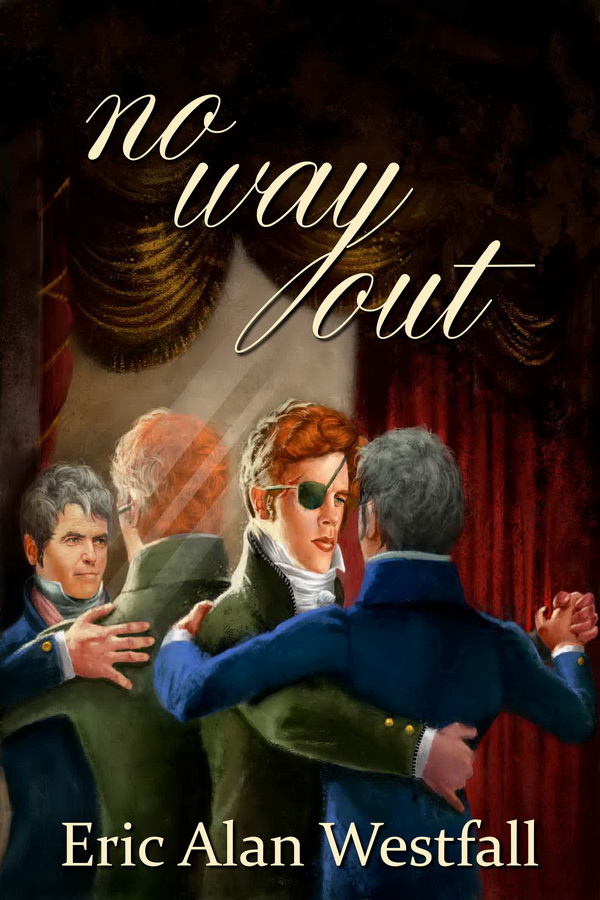
QSFer Eric Alan Westfall has a new MM historical romance out:
It’s April of 1816 in Another England.
And Jeremy—a whore from the Dock—is living in a guest bedroom at the London home of the (in)famous Iron Marquess, with over fifteen days missing from his life.
For someone who remembers everything from his third birthday on, it’s unnerving not to know. Fine, fourteen days for the coma and the infection delirium. But those first thirty-six hours. Do they explain how he got hurt, how he got to Ireton House, and why his lordship’s mountain-sized valet is taking care of him? Or why his ironness looks at him with nothing iron at all in his eyes?
Jeremy and the Iron Marquess both have dark secrets. Forced engagements, an inheritance, a scheme to clap Jeremy in Bedlam, the revelation of the missing hours, a problem with plumage, some numbered accounts, and a long sea voyage, all seem to mean there’s no way out of the snares surrounding them. Or is the old saying true: where there’s a waltz, there’s a way?
All royalties will go to a local LGBT organization.
Universal Buy Link | Amazon | QueeRomance Ink | Goodreads
Giveaway
Eric is giving away two backlist eBooks (ePub or mobi) to one luck winner. Enter via Rafflecopter:
https://widget-prime.rafflecopter.com/launch.js
Direct Link: http://www.rafflecopter.com/rafl/display/b60e8d4726/?
(Exclusive Excerpt)
From Chapter 11: The Third Time Is Not A Charm
IRETON
23 April 1816
9: 15 a.m.
Ireton House, London
Geoffrey Hayward-Brown, who had perhaps hyphenated his name to give him a false illusion of gentility, picked up the portfolio and clutched it to his plump bosom.
Inside the outer prosperous, satisfied hog was a sly, thin weasel, not clamoring to get out, but content to hide in the shadows thrown by the solicitor’s falsely bright bonhomie.
Yet both inner weasel and outer fat man were nervous. He glanced away again, and then did whatever version of summoning up the blood and stiffening the sinews weasels do before being forced into battle. Weasels do not willingly fight, but only do so when compelled, or bribed.
The air in my parlor suddenly felt as if a white-gloved finger swiped through it would come away not merely smudged, but fouled. I had not followed through, last time, with my joking reference to the parlor needing a cleaning after the baron’s last visit, but this time, I might.
This was a man who dealt in agreements, in plots and plans which did not merely hover at the farthest edges of the law’s limits, but often went well beyond, though cloaked in seeming propriety. Today was a part of one such agreement.
The baron extended his hand and snapped his fingers. “The documents!”
The weasel looked a bit relieved he might not have to directly deal with me after all. He hurriedly opened the portfolio, and tugged out several documents which he handed to the baron. He in turn glanced at them, presumably to ascertain they were the ones he wanted, and presented them to me. I did not take them.
Instead, I turned to the two constables, and removed a good part of the ironness from my voice. “Gentlemen, may I assume you are here at his—” a very slight head-tilt indicated the baron “—behest?”
The older took a moment to work out the “behest,” before saying, “Y-yes, my lord.” The younger did his best not to look as anguished as he felt. I would not want him to wet himself, so I did not give him any of my attention. The older was, I thought, experienced and strong enough to endure.
“I believe my discussion with these two…gentlemen—” I heard the indignant huff of air, probably from the baron, but ignored it “—needs to be private. As I am confident nothing will occur which would require your services, perhaps you might wait elsewhere? If you would not mind the kitchen, I understand my cook has made some of her quite remarkable lemon tarts, and is, as the saying goes, rather a dab hand with sandwiches and cool ale.”
The older constable’s eyes said, “Oh, Lord, yes, my lord. Thank you!”
What came out of his dutiful mouth was, “I am not sure we should, my lord. It…it is a serious matter we are here about, and—”
“Excuse me, constable, for interrupting. But you are…”
“Um. Constable Howard, my lord. And, uh, this is Constable Stewart.”
“Excellent. I believe your superior is Sergeant Knowlton?”
His jaw dropped, and then he clamped it quickly shut. “You…you know Sergeant Knowlton, my lord?”
I could not in truth say I knew him well, but I had made sure since the information from Somerset House came in, to make the acquaintance of all those in charge of the police stations within a reasonable radius of Ireton House. In person. Inquiring about the nature of their work; their thoughts on how their great services to London might be improved. Making a reasonable, or even a close-but-not-quite-outrageous, donation to the fund which provided assistance to the widows and orphans of policemen who died in the line of duty, and for those who became unable to work for the same reason.
It was not, of course, a bribe. Merely my civic duty. And while I suspected of one “superior” the entirety of my donation would never reach those who managed the fund, it was a matter to be addressed later. Sergeant Knowlton was not that man, and he had impressed me.
“Not well, Constable Howard. But I can in good faith say I believe he would not feel you had been remiss in your duties if you were to allow us this private conversation.”
The relief of both constables was palpable.
It had taken a great deal of courage for Constable Howard, solely in the name of duty, to deny what was a clear command, though couched as a request, from a very high-ranking nobleman. I would have to ensure he was suitably rewarded, in terms of his career, at some later date when it would not appear to be a bribe, even though any assistance I might provide would not in fact be a bribe. Courage in any form should be recognized.
As Brendan’s courage had not been. As it would be, I hoped.
“I must protest, my lord!” the baron said.
Protest away, I thought, but only replied. “If you must, Lord Enderby, if you must. However, I believe these gentlemen understand a private conversation with you and your solicitor” —weasel— “will not result in me scarpering off towards parts unknown, and leaving them and you behind to raise a hue and cry.”
I turned, went to the door, opened it. Carleton was there.
In my younger days, much younger, when I still had fancies and fantasies, I almost believed Carleton was a genie with bottles lurking everywhere, given the speed with which he was present when he was wanted.
“Ah. Carleton. If you would be so kind as to escort the constables to the kitchen? We are going to have a quiet conversation here, and as I have regaled them with the tale of Mrs. Bentley’s lemon tarts and superb sandwiches, I thought it would be an appropriate place for them to wait. I have, you see, promised them I would not run away.”
Carleton naturally did not blink at any of this folderol, but he unquestionably understood the status of the constables had changed from unwanted interlopers to visitors who were to be treated with courtesy and respect. “Of course, my lord.” He looked past me at Howard and Stewart. “Constables. If you would be so kind as to follow me?”
With patent relief on their faces, helped by the generous “be so kind” in lieu of a butlerian command of the type to make constables quake—a relief they did not allow to become visible until their backs were to the baron—they departed. I closed the door behind them, and turned back to the still-standing baron and solicitor.
Author Bio
Eric is a Midwesterner, and as Lady Glenhaven might say, “His first sea voyage was with Noah.” He started reading at five with one of the Andrew Lang books (he thinks it was The Blue Fairy Book) and has been a science fiction/fantasy addict ever since. Most of his writing is in those (MM) genres.
The exceptions are his Another England (alternate history) series: The Rake, The Rogue and the Roué(Regency novel), Mr. Felcher’s Grand Emporium, or, The Adventures of a Pair of Spares in the Fine Art of Gentlemanly Portraiture(Victorian), with no way out(Regency) coming out a month after Of Princes.
Two more fairy tales are in progress: 3 Boars & A Wolf Walk Into A Bar(Eric is sure you can figure this one out), and The Truth About Them Damn Goats(of the gruff variety).
Now all he has to do is find the time to write the incomplete stuff! (The real world can be a real pain!)
Author Facebook (Author Page): https://www.facebook.com/Eric-Alan-Westfall-1045476662268838
Author Twitter: https://twitter.com/eawestfall43


 Buy it Here
 Scattered Thoughts and Rogue Words