A MelanieM Review: Wild Bells by Charlie Cochrane


Rating: 5 stars out of 5

wild-bellsWild Bells, two historical novellas.

The Shade on a Fine Day:
Curate William Church may set the hearts of the parish’s young ladies aflame, but he doesn’t want their affection or presents, no matter how much they want to give them to him. He has his sights set elsewhere, for a love he’s not allowed to indulge. One night, eight for dinner at the Canon’s table means the potential arrival of a ghost. But what message will the spirit bring and which of the young men around the table is it for?

The Angel in the Window:
Two officers, one ship, one common enemy.
Alexander Porterfield may be one of the rising stars of the British navy, but his relationship with his first lieutenant, Tom Anderson, makes him vulnerable. To blackmail, to anxieties about exposure—and to losing Tom, either in battle or to another ship. When danger comes more from the English than the French, where should a man turn?

Charlie Cochrane is one of our top m/m historical fiction authors.  Her stories center us and her characters in their era and cultures effortlessly, plunging us into the niceties of teas, obligation,and  respectability. A place of insular cultures and a society where loving a man and sodomy will get you and your lover hanged. In Wild Bells, Cochrane offers us up two stories.  Each beautifully written, a treasure of romance, and love found within the strictures of the laws and ways of that time period.

The Shade on a Fine Day sees the journey of one young curate to what it is he really wants and the courage to reach out and ask for it.  For the author, she always keeps in mind what is plausible and what is not within that time frame and sensibilities.  When her story plays out, as it does gently, sweetly and with love, you can see it happening and you believe in it.  I loved this story.

The Angel in the Window is a friends to lovers story that is anything but simple.  Layered and deep, the story of Alexander and Tom’s relationship is colored by the fear of discovery.  That even the hint of something less than reputable could lose them their reputations,their Commissions, their standings, even their lives.  Its the law of the land and its followed strictly.  How Alexander and Tom work through this is another Cochrane hallmark and its one that had made me a fan since I first discovered her through her Cambridge Fellows Mysteries.

This is a wonderful two story treasure.  Its perfect for the holidays but really any time of the year.   Pick up it and revel in the lovely writing and romances of Charlie Cochrane.

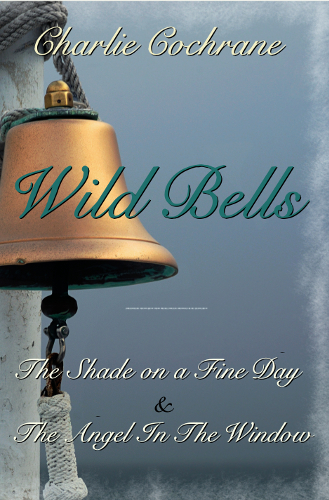
Cover art is simple yet effective.

Sales Links

7104e-waxcreative-amazon-kindleBook Details:

Kindle Edition, 131 pages
Published December 1st 2016
Original TitleThe Shade on a Fine Day and The Angel in the Window
ASINB01NA785ID
Edition LanguageEnglish
Charlie Cochrane on Writing Historicals and her holiday release ‘Wild Bells’ (guest blog)

wildbells500x329

Wild Bells by Charlie Cochrane

Purchase at  7104e-waxcreative-amazon-kindle

5668c-goodreads-button

Scattered Thoughts and Rogue Words is happy to have Charlie Cochrane. one of our favorite authors, here today to share with our readers about writing historicals and her latest release, Wild Bells. Welcome, Charlie.

~

Why does “blizzard” make Charlie twitch?

The word “blizzard” makes me shudder. Not because I’ve ever been stuck out in one (although we did once have the most horrendous snow affected car journey) but because I used it in speech in the first edition of my Regency, “The Shade on a Fine Day”.  Now, it sounds a nice old word, doesn’t it? You can imagine King Lear blethering on about blizzards on the blasted heath. It isn’t. It’s late Victorian and comes from North America so my nice, gay Regency curate couldn’t have used it, unless he actually coined the word and it then somehow crossed the Atlantic.  Having the book come out in a revised edition has allowed me to correct my error!

I have to admit that no readers have ever taken me to task for this mistake, because it’s not an obvious blooper, but I know, which is quite sufficient. Sometimes authors are their own hardest critics. I hate getting anything wrong in my historicals, although things do slip through and my wonderful editors usually catch those, but the odd bit of stuff creeps into the final text, usually because something sounds old and isn’t.

Writing historicals can be a tricky business. To start with, that a lot of the challenge lies in the conscientious author’s head. If we didn’t care about getting things right, we could just plough on, putting the sound of Big Ben’s chimes into a Regency or letting our Victorian hero eat Jelly Babies, not checking dates and times and brands and all the other things which keep authors awake at night. We have to remember to get our men to raise their hats to a lady, to dress for dinner and to use the right words.

There is also a cadence and a rhythm to language, which makes some historicals (be they novels, films or tv programmes) sound out of kilter. I’d say to any aspirant historical writer to read things from the era they’re looking at. Novels, newspapers, plays, anything to get a feel for the words and the way they were used.

Now, there’s always the argument that says that the past isn’t so different from now. People haven’t changed, not matter what people say about the (surely imaginary) “good old days”, when everyone was decent and honest. I’m sure Ham, Shem and Japhet probably cheated at Ludo to get one over on Noah. I was recently reading about two Irish forwards dumping a Welsh rugby player into the crowd during the game, leaving him with nasty injuries including a couple of fractured ribs. Back in 1999? No. Back in 1899.

Human nature remains recognisable, even if the experiences and social conditions which play such a part in moulding people are different according to the time and place where they were raised. So getting it right in the story isn’t just a matter of language or customs, it’s about attitudes and expectations. I recently heard a keynote speech (at the Queer Company event) which illustrated the huge differences between the Regency era – the sort of period in which both the Wild Bells stories are set) and the Victorian age, and how that transformation had come about due to a number of factors such as movement into cities and economic changes. Fascinating stuff, all of which was new to me, even if I knew about the consequences.

The past has a wonderful capacity to surprise us; and sometimes it catches us out.

Wild Bells – Two stories by Charlie Cochrane

The Shade on a Fine Day:
Curate William Church may set the hearts of the parish’s young ladies aflame, but he doesn’t want their affection or presents, no matter how much they want to give them to him. He has his sights set elsewhere, for a love he’s not allowed to indulge. One night, eight for dinner at the Canon’s table means the potential arrival of a ghost. But what message will the spirit bring and which of the young men around the table is it for?

The Angel in the Window:
Two officers, one ship, one common enemy.
Alexander Porterfield may be one of the rising stars of the British navy, but his relationship with his first lieutenant, Tom Anderson, makes him vulnerable. To blackmail, to anxieties about exposure—and to losing Tom, either in battle or to another ship. When danger comes more from the English than the French, where should a man turn?

wildbells500x329

About the Author

As Charlie Cochrane couldn’t be trusted to do any of her jobs of choice—like managing a rugby team—she writes. Her favourite genre is gay fiction, sometimes historical (sometimes hysterical) and usually with a mystery thrown into the mix.

She’s a member of the Romantic Novelists’ Association, Mystery People, and International Thriller Writers Inc., with titles published by Carina, Samhain, Bold Strokes Books, Lethe, MLR, and Riptide. She regularly appears with The Deadly Dames and is on the organising team for UK Meet.

To sign up for her newsletter, email her at cochrane.charlie2@googlemail.com, or catch her at: