Review: Captive Magic (Sentinels #3) by Angela Benedetti

Rating: 3.75 stars

Captive MagicBreckenridge “Breck” Bayes is both a telepath and teleporter.  And it his last gift that brought him to the attention of a demon in search of an object.  Normally Breck would have said no but nothing in Breck’s world was normal at the moment.  His kid sister is dying of cancer and there is nothing the doctors can do for her.  But if Breck agrees to work for the demon, then his sister will be cured.  But the demon’s demands keep growing and each time Breck fails, the demon makes his sister sick again.  Breck is desperate to finish their deal but he can’t find the object the demon wants and he is getting desperate.

Manny Oliveira, owner and operator of the bookstore the Grove, is a seer and Sentinel.  So it makes perfect sense that when someone sees a man teleport in and out of a local shop, the first one they report it to is Manny.  When Manny chases Breck down mid robbery, Breck’s explanations for his thefts tug at Manny’s heart.  Manny understands totally about family and love for the youngest members.  So  he decides to help Breck get free of his obligation while leaving his sister healthy, a huge undertaking and one he is not prepared for.  Because the demon Breck is working for wants Manny’s talents as well.

With both men in trouble and a demon holding them in peril, what happens when you add love to an already unstable mixture?

Captive Magic is the first book I have read by author Angela Benedetti so I was unaware that it was the third book in a series that is five stories deep including this one (see list below). I found out about the series after the fact and that explained some of the lack of back history associated with Captive Magic and the Sentinel group. Clearly the author has provided the Sentinel backgrounds in previous books (or so I assume).  So I am going to exclude that issue from my review except to say I wish that a minor recap had been given and continue on as though it is a stand alone.

I did find much to admire about Captive Magic on its own terms.  Angela Benedetti has a marvelous imagination and ability to craft an ingenious story plot.  Captive Magic combines those elements with terrific and appealing characters and you have the makings of a great story and certainly a series.  I found all the characters here, with the exception of the “demon” likable, realistic, and certainly capable of holding their own against the weight of the wild elements found within this story.

Benedetti supplies both men with heartwarming and recognizable families, from the heartbreaking Amanda, Breck’s sister, who is dealing with her cancer and the strain upon her family, to the bright, and incorrigible Anita, Manny’s niece, and Amanda’s healthy opposite. “Manda” especially tugs on our heart strings with her brave but realistically tough outlook on her illness and her future.  Breck’s mother, weary, strained, and doing what is necessary to keep her family together is a portrait of a mother under incredible pressure and the fractures are beginning to show.  By placing both men within a strong, and loving family structure, Benedetti makes us understand Breck’s agreement and subsequent stealing.  When forced to choose between a child’s life and a theft of an object,, who wouldn’t choose the child, especially when the medical world has failed her?

Less successful is her choice to have Manny assist Breck on his own, without any help from the other Sentinels. Sentinels, who (by the events that occur later in the story), are clearly better equipped to have handled this situation as a group.  Manny has this whole cadre of magic users at his disposal.  One even asks him at the beginning what is going on “with the teleporter” but Manny lies about his knowledge and involvement.  For no discernible reason other than the author needed him to do so for her plot to work.

At one point in the story Breck tells Manny “this is pointless” and so it is.  With so many other incredible elements here, why would you not have a better, more reasonable, more logical explanation for Manny’s actions then the nonexistent one Benedetti supplies the reader and Manny with.  This is a huge missed step, one of several that pulls the story (and the story’s ratings) downward.

Another aspect of this story, that of another dimension brings out the best and the worst with Benedetti.  The best includes a wildly imaginative world that combines elements of math, physics, Harry Potter and the unknown into a simply stunning new dimension.  Here is an excerpt:

 The passages wandered all over, around corners, up and down slopes, through doorways and in and out of huge rooms or caverns or whatever. Breck never spotted an obvious light source; it was like the photons were just sort of bouncing around at random, keeping everything generally lit, with no shadows and no bright spots. It was like a maze full of water; water didn’t pile up in one place or leave a hole someplace else, and the light was behaving the same way. It was weird.

They climbed over a raised lintel, sort of like the hatchways on ships, and into a medium-sized cavern. There was a cluster of… sculptures? growing out of the wall to the left, or maybe they’d been stuck there for some reason? Breck hauled Manny over so they could get a look.

“Is this what you saw?” Manny was squinting at one of the little thingies, then another. “They’re weird, man. It’s like a Klein bottle or something — or two or three of them stuck together.”

Breck decided not to ask what a Klein bottle was; he just checked out all the weird sculpture-things and shook his head, trying not to follow their loops and spouts too far ‘cause they made his eyes water. “No, none of these. It was bigger, I think. Hard to tell size, but there was more to it, and there was a bigger smooth part on one side — these all have handles and knobs and stuff all over them.”

The more she describes it the weirder it gets.  And that’s great because if we are confused it helps us understand what the characters are feeling as they stumble through the passages in this dimension.  But then it becomes too much of a good thing, as they start popping in and out of the action, most of which is occurring back in their original world.  Soon all the little details the author used to embellish this dimension and her story start to bog down the narrative and disconnect the reader from the characters and their mission.  You know the story is in trouble when one character is left to sit on the floor while the other “pops” out to confront the demon and the pov stays with the person on the floor, whiling away the time until the other man reappears to explain things.

At this point several things have occurred to undercut the momentum of the story and the anticipation that the author has built up.  The readers never really get their “aha” moment with the so called “demon”, that just kind of melts away, undeserving of the huge buildup of “dark, nauseating” descriptions of what it feels like when they interact with the demon and its demands. It’s almost like getting Pooh Bear under the sheet instead of Freddy Kreuger.  Instead of giving the first part of her story its due with a satisfactory conclusion, the author manufactures a secondary trauma and expends all her energies and exposition on it, another miscalculation in my opinion.

Mixed in with everything else that is going on is a “instant love” story that lacking a believable romantic time frame gets it own jump start that once again asks that the reader suspend their disbelief and accept the author’s explanations for a deep and abiding love between Manny and Breck.

Unfortunately this is not the first time the author has called on the reader’s goodwill and ability to believe in her story and then treated that gift somewhat shabbily.  Towards the end of the story, Manny (and Breck) easily accepts the aid of the other Sentinels, the same aid he rejected at the beginning, with no reasonable shift in attitude.  For the reader to have accepted Manny’s lying and avoidance of any assistance from his other Sentinels, the author would have had to supply a better justification than the shallow ones given.

In the end, all the great characterizations, wonderfully inventive world building, and catchy dialog have a hard time surmounting the detail overkill, as well as a story that bogs down under its own cleverness and abundance of plots. In fact Benedetti’s inability to bring the major plot to a satisfactory close, sacrificing it to put into motion another more angst driven secondary story line is such a huge error, in my opinion, that it almost negates the goodwill and expectations that came before.

Even with all my frustrations and issues with Captive Magic, I will still recommend it with reervations.  If you are a fan of the series and Angela Benedetti,, I know you will want to pick this one up. If you are a fan of fantasy and the paranormal, then this has enough terrific elements to make it worth reading.  But if you are in it just for the romance alone, then this is probably not the book for you.

Cover illustration by BSClay is a marvel, perfect for the story.

Book Details:

ebook, 307 pages
Published September 4th 2013 by Torquere Press
edition language English
series Sentinels #3
Books in the series include:
A Hidden Magic (Sentinels #1)

 Unfinished Business (Sentinels #1.5)
Reach Out and Touch (Sentinels #1.6)
Chasing Fear (Sentinels #1.7)
Emerging Magic (Sentinels #2)
Captive Magic (Sentinels #3)
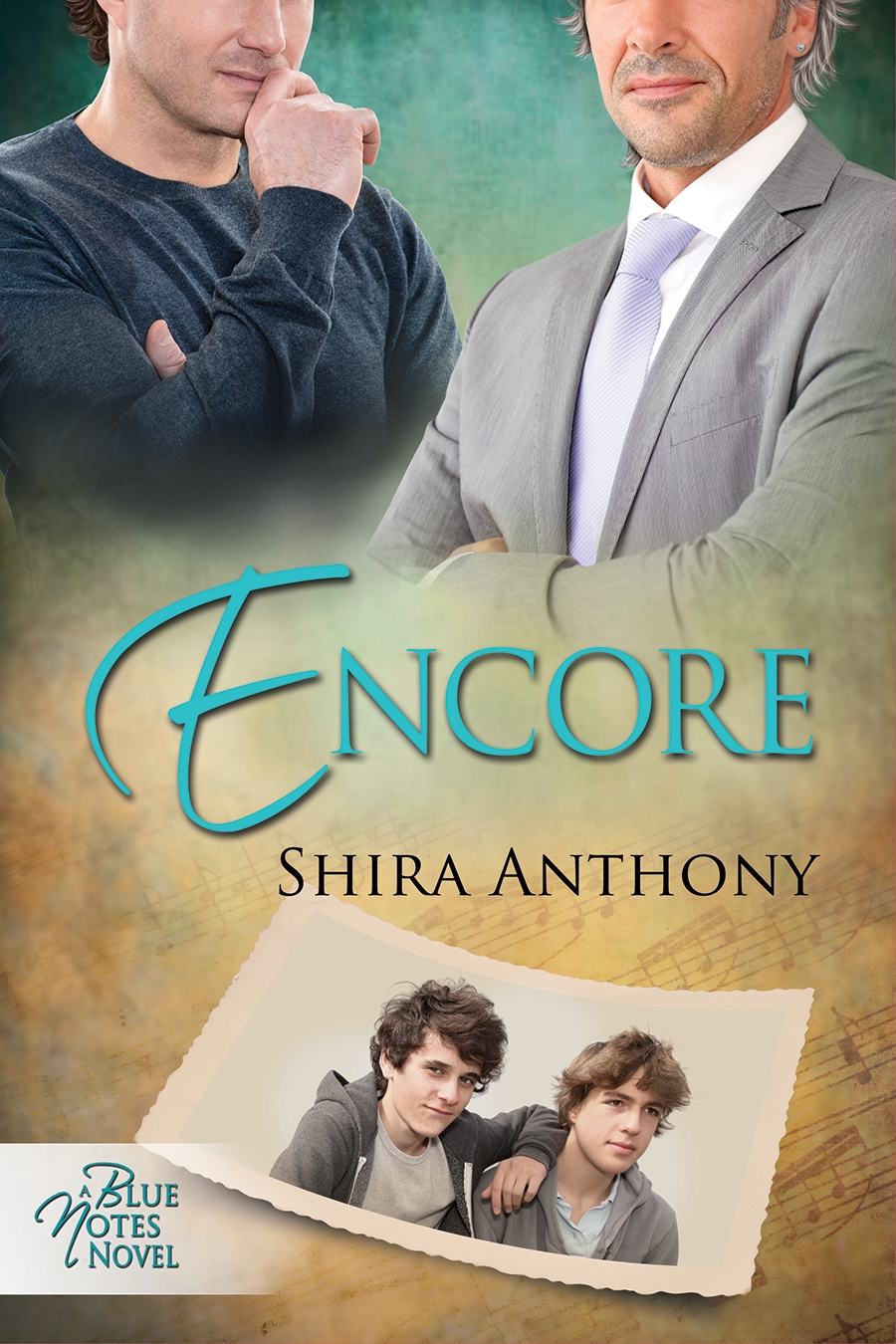
Review: Encore (Blue Notes #5) by Shira Anthony

Rating: 5 stars out of 5

Encore-BuildWhen teenagers Roger Nelson and John Fuchs  meet in the band room of Maryville’s Senior High School in 1971, they discovered they shared the same passion for music.  Roger Nelson with his violin and John Fuchs with his dream of conducting.  Each teenager came from different backgrounds and moved in different circles in high school, Roger Nelson, the “cool kid” popular with all crowds and John Fuchs, the stuttering, shy transfer from St. Barnaby’s, an expensive private school.  Brought together by music, they soon developed a deep friendship that made them inseparable.  Then it turned into something more.

John had always known he was gay so his love for Roger seemed natural and right. However, Roger’s attraction and love for John confused him, making him feel unsettled and insecure especially in the 70’s where homosexuality was still looked at with disgust and ignorance.  Together through college and graduation, John and Roger continue their secret romance despite growing opposition from Roger’s parents. Then two tragedies occur that immediately impact Roger and his family.  The ripples from those events serve to separate Roger and John, shattering their romance but not their love for each other.

For the next several decades, the men’s lives intersect only to  be pulled apart time and again.  When one more event brings them back together, will this be the encore they have been waiting for or will their last chance at love slip away forever?

Encore is Shira Anthony’s most ambitious and deeply layered Blue Notes story to date.  Over the course of the Blue Notes series, Anthony has been building a symphony of characters deeply involved in the world of music and their relationships.  Whether it was a pianist or conductor, violinist or opera singer, cellist or lawyer in the musical entertainment industry, Shira Anthony has introduced us to the men whose passions for music has driven their lives, loves, and careers. But those previous stories, for the most part,  have had a specific  short time span for the men and their love affairs.  Now in Encore, Anthony goes for the larger picture, not just a movement but the whole composition.  Here she strives for a symphony and achieves it.

Encore is a musical term derived from the French word “again”.  It is a repeat performance or an additional musical piece that occurs after the main piece or event concludes and it is the perfect term to apply to the on and off again relationship of Roger Nelson and John Fuchs, two characters introduced as a couple in previous novels.  Starting in 1971 and ending in 2006, Anthony creates a romance that encompasses a 35-year time frame.  It will see the beginnings of the AIDS epidemic, the fight for gays rights, and finally the beginnings of social acceptance of homosexuality.  Against such a historic and dramatic background, the author has created her most textured and multidimensional romance in this or any other series.

Even at the beginning of John and Roger’s relationship, each young man has their personalities already firmly in place.  John is already comfortable being gay, even in 1971.  The kids have already taken note of his “difference”, an aspect of his personality that will only deepen as John ages and finds his own style, totally comfortable in his skin and element.   And while John may stutter in emotional situations, his belief in himself and his music is unwavering.  I loved John.  I understood his behavior and his emotional outlook on life and his music because Anthony has made him so transparent and accessible even with all his layers.

Then there is Roger.  The wonderful, exasperating, heartbreaking Roger.

Roger Nelson inside is the antithesis of his outward appearance and behavior.  On the surface, Roger is all “coolness” and popularity, his easy nature and charm crossing high school and then college social circles.  But inside, he is a tumultuous mess.  Pressures from his parents, society, and their expectations for Roger’s future collide with his own dreams for himself and the resulting avalanche will derail everything Roger and John had planned for their lives together.  While all Roger’s friends and family is aware he loves music, none but John understand how crucial it is to Roger, that music and the violin are fundamental parts of Roger, as necessary to him as food and air. It’s that essential part of Roger that is lost or an aspect of it is lost.  And for the reader, it is important that we are able to connect with that feeling in order for us to really understand  Roger and his actions.  For Roger, the loss of music and his ability to play the violin is nothing less than the deepest wound to his soul, like losing an appendage.  The hole it leaves behind can never be forgotten or overlooked.  Roger too feels so real, a living, breathing walking gash of a man.  And, due to the author’s deep connection with her character and her ability to bring this man to life, Roger is also the character that will engender a wide spectrum of feelings from the readers.

Roger has the ability to become such a misunderstood character in this story if the reader doesn’t take the time to put him into perspective, both historically and emotionally.  John never had the pressures put on his that Roger has had throughout his life.  Nor has John had to deal with the worst thing that could possibly happen to himself and Roger.  That is the loss of their music, the destruction of all their hopes and dreams and that is exactly what happens to Roger early on in their story.  This loss guts Roger.  It takes his heart and shatters it, leaving Roger incapable of going forward with his life as a whole person.

I think that Shira Anthony captures that feeling, that crushing loss, and it’s resulting reverberations on someone’s emotions and behavior realistically and with great pain and insight.  The author has stated that in many respects “Roger” is her.  Roger, his  character, is her outlet to express the emotions and heartbreak she felt upon leaving her career as an opera singer behind.  And it shows in the realness, the pain, the constant turmoil and upheavals in his life that Roger finds himself going through.  She made me believe in Roger totally.

At times the reader will be frustrated with Roger’s  actions.  Trust me, I was.  But again, you need to keep in mind that the man going through the various stages in his life is a man bereft of his center, his heart.  Then Roger becomes someone who needs our compassion and empathy as well as our understanding.  I think so many of us can point to moments in our life when things went awry.  Maybe it was a slight altering of goals or a detour taken that we notice only in hindsight.  But for Roger and so many others, there are life shattering events and decisions that send them off on a journey they never expected or wanted.    Accident or warfare, a missed step or terrorism.  The why is sometimes less important  than what happens after.  And here, in Encore, Shira Anthony lays it all out for us as it takes Roger 35 years to come to grip with his eviscerating loss and his love for John.

As we watch Roger and John come together only to separate once again, I am reminded of the various acts in an opera.  Just as an opera has various acts, stages it must go through,  so is this book divided into different periods.  Each division moves the story forward, sometimes just a couple of years or so, sometimes a decade until we arrive at the last act and the highly satisfying encore.  This is an emotional journey, full of the cracks and crevasses that come over time and with two such diverse men at the center.  Have the tissues handy, you will need them. as this story has the ability to make you weep as well as smile.

I can’t say it enough, Encore is such a remarkable story.  It is definitely one of the best of 2013.  It is a symphony of emotions, its instruments the men Shira Anthony has created along with their deep love for music and each other.  Encore will have you calling for a repeat performance from this incredible author.  Brava, brava!

As with all her stories, here is the link to the playlist for Encore. http://www.shiraanthony.com/books/encore/#extras 

Cover art by Catt Ford.  This cover is perfection in every way, from the picture of the two men as boys to the branding that keeps it similar in look to the other Blue Notes covers.

Listed below are all the stories in the Blue Notes series.  The author has noted that she considers it a series of interrelated, classical music themed standalone novels that can be read in any order.

Knowing (Blue Notes, #0.5) a free read at Goodreads
Blue Notes (Blue Notes, #1)
The Melody Thief (Blue Notes, #2)
Aria (Blue Notes, #3)
Prelude (Blue Notes, #4) by Shira Anthony and Venona Keyes
Encore (Blue Notes, #5)
Symphony in Blue (Blue Notes, #4.5) Expected publication: December 25th 2013 by Dreamspinner Press

Book Details:

Guest Post: Shira Anthony, Mega Contest Time and the Release of Encore!

BlueNotesSeries_FBbanner_DSP[1]

“Moving on from Music” by Shira Anthony

Thanks, Melanie, for hosting the Encore release day party on your blog! It’s such a pleasure to be here today. I’d crank up the music, but I’m not sure if we should play Tchaikovsky or The Who. Roger and John might be just as conflicted. They love just about any kind of music.

Those of you who have read any of the Blue Notes Series books probably know that the books are loosely based on people and events from my own life as a professional musician. I’m a former violinist and professional opera singer who gave up my music career about 15 years ago. It was one of the hardest things I’ve ever had to do, but I don’t regret the decision. But having no regrets doesn’t mean “no pain.”

Ask yourself how many people you know who have studied music at the college level or beyond. I bet you can name a few (you may even be one!). How many professional musicians do you know? I know a lot of former professional musicians. There’s a reason for that: it’s an incredibly demanding career that requires total focus, pays poorly (unless you’re a superstar), and often means a nomadic lifestyle (not great for long-term relationships and family). There are many more former musicians than there are professionals. But how do you give up something you love nearly as much as you love the people in your life? The grief is very much like the grief you’d feel over the loss of a loved one.

I know. I’ve been there.

Two of the Blue Notes Series characters are former musicians: Jason Greene from Blue Notes, and Roger Nelson from Encore. Each deals with his grief over the loss of his music differently. For Jason, the perfectionist whose fear of performing became overwhelming, he finds a way to make peace with himself and accept his imperfections. Roger, however, is a different story. Roger loses the physical ability to play the violin. His musical voice aches to be heard, but his body (his hand) can’t translate the music of his heart into sound. It’s the most devastating loss of his life, and one he struggles to come to terms with over many years.

I don’t think it’s a surprise that it took five Blue Notes books for me to finally write my own loss into a Blue Notes character (Roger’s character). A musical soul needs to express itself, but it’s difficult to move forward when you aren’t sure how to do it or where to go. Roger tries to forget about his music and deny his grief. It’s only when he realizes there are other forms of self-expression that he can move on with his life and truly love. I’ve found a new outlet for my own self-expression in my writing and learned how to incorporate my love of music into my books. Even better, readers can still “hear” that musical voice in my books. So I guess in some sense, I haven’t really given up performing, have I?

Encore’s release will be followed on Christmas Day by the release of a Blue Notes holiday novella, Symphony in Blue. SymphonySymphony in Blue-build (1) will be my 10th Dreamspinner Press release, so I’m celebrating the release of both of these books with a blog tour contest ending on New Year’s Eve at midnight! Grand prize is a Kindle loaded with many of my Dreamspinner Press titles. You can get more entries by commenting on blog tour posts, tweeting, and buying the books. Here’s the link to the giveaway:

Contest Details for Blue Notes Series Holiday 2013 Giveaway:

  • Begins on release day for “Encore,” November 11, 2013
  • Ends on New Year’s Eve, December 31, 2013, at midnight
  • Drawings are open to both U.S. readers and international readers, but physical prizes (Kindle, necklace, book, and t-shirt) are for U.S. readers only. I will award a virtual set of the first 4 Blue Notes Series books to one winner from outside the U.S.

Prizes (U.S. Only):

  • Grand Prize: A Kindle loaded with the first 4 Blue Notes Series books and some of my other back titles
  • 1st Place: A sterling silver music themed necklace
  • 2nd Place: Winner’s choice of one of my back titles in paperback (i.e., not including the 2 new releases)
  • 3rd Place: Blue Notes t-shirt, cover of the winner’s choice

Encore-BuildBlog Stops Currently Scheduled :
November 11th (release day – Encore): Scattered Thoughts and Rogue Words (Melanie Marshall)
November 12th:   Live Your Life, Buy the Book
November 14th:   Michael Rupured’s Blog

Review: Illumination by Rowan Speedwell

Rating: 4.5 stars out of 5

Illumination coverExhausted from his last performance on his band’s final tour,  Adam Craig, lead singer of the rock band Black Varen, returns to his suite to find it filled with his fellow band members and hangers-on partying out of control.  Adam feels burnt out and dissatisfied with almost every aspect of his life and now he’s had it.   Adam really wants to be back on stage, his real love. Plus, Adam is deeply in the closet, appearing to be straight because of his career.  Adam has always known he is gay but with a homophobic guitarist and Black Varen’s  fans to think about,  Adam has been forced to hide who he really is.  Now the secrecy and denial is wearing him down.  Escaping the party in a cab, Adam winds up hours way at a lake resort he remembered visiting often as a child.  It was a time and place where Adam had truly been happy.  Now its closed and the entrance chained. But a drunken Adam is not to be denied and he climbs over the chain and wanders around until he ends up falling asleep in a chair on the deck of a lakeshore cabin.

Miles Caldwell, a brilliant artist, lives in a cabin on the lake resort that his parents owned, now the property of Miles and his sister. It is the perfect place for an artist like Miles to live and paint.  It is also the only place Miles can live and stay sane.  Suffering from agoraphobia and social anxiety, Miles needs the isolation and quiet that the lodge and its surroundings give to him.  Unable to leave the resort, Mile’s only companions are his African Grey parrot, Gracie, his sister when she visits, and two old friends, a couple who help keep Mile’s grounded.

Mile’s spends his days illuminating manuscripts, often losing tracks of the hours he paints, consumed by the intricacies and tiny embellishments he creates for his masterpieces.  When Miles discovers Adam asleep on his porch, his first inclination is to call the police and have the intruder arrested.  But after introductions are made, each man is soon charmed by other.  Adam by Mile’s lack of knowledge as to his fame as a rock star as well as Mile’s gentle nature and idiosyncratic ways. And Mile’s? Well, he is enamored of just about everything about Adam, including his charm, gorgeous body and intelligence.

Before each man knows it, their accidental meeting turns into a two week romantic idyll.  Although each man tried to keep their affair light and complication free, just the opposite is happening.   When the demands of the band and his rock star way of life calls Adam away from Miles, can a man whose demons keep him trapped at home find a way to happiness with Adam, a man always on the run and still in the closet?

What is illumination? According to Webster’s, illumination is the act supplying or providing light to make something visible or bright. It is also the  manner in which an artist creates an elaborate decoration of the text of handwritten books with gold or, more rarely, silver, giving the impression that the page had been literally illuminated.  In other words, the page illustrated glows with light.   Rowan Speedwell uses both meanings of the word in her novel Illuminations to create a story that glows with its tale of love and redemption.

Speedwell has created two main characters, each a man carrying a darkness within them, both in need of love and passage to a happier life.  I loved both men.  The author has done a marvelous job making these men complicated real people, each layered with a variety of quirks, gifts, and oddities to their personalities.  And of course, each man also has his own individual demons to fight.

Adam is probably the most recognizable and even relatable of the two men.  He is a rock star tired of his fish bowl existence. He hates hiding who he really is, whether it is his sexuality or his love of the stage. Adam keeps both hidden and is paying the heavy price of denial with several types of self inflicted injuries.  He is using his best friend as a beard, having casual sex that later disgusts him and he is taking too many drugs.  Adam uses drugs to deal with life, not recognizing that it is getting out of control.   Rowan Speedwell paints a picture of an unhappy man who is self destructing with no way to stop it.

Her second character is astonishing in so many ways.  I never saw Miles Caldwell coming.  He is truly a unique creation.  Without going into spoilers, there is so much about Miles that will surprise you.  He is a artist of a very specific art form, one that is centuries old.  He illuminates text and he does so using the old methods.  He is brilliant in his artistry and known only by a small group of collectors and buyers.  His world is a much smaller canvas in all ways, not just in his artwork.  Due to his agoraphobia, social anxiety, and other issues, Miles has restricted his universe to his cabin and the lake shore in front of his cabin.  His companions have been winnowed down to his parrot Gracie, his sister Lisa, a lawyer, and two old friends, now a couple, who have known him since childhood.  And all contact with the outside world is handled either by phone, computer or by the delivery men.  It is a tight, small place in which Mile’s lives and feels safe.  And Speedwell brings the reader into Miles’ world gently and with an intimacy that makes us realize what Miles has both gained and lost in the hand life has dealt him.

Mile’s world is itself embellished by the secondary characters Speedwell creates to support him and shore him up mentally and emotionally.   Lisa is a heartbreakingly sturdy and loyal sister.  She has lost as much as Miles has, perhaps even more, and yet there is so much to admire about her.  Lisa is a well rounded creation and you will want to shed tears along side her when her pain and frustration gets too much and overwhelms her.  At little more on the odd side is Bobby and Doug, a  gay couple who have been friends with Miles for years.  Bobby, in fact, has been Miles  sex buddy with the complete approval of Doug, his long term partner.  With certain restrictions of course, because those sexual acts belong to Doug alone.  It’s a strange little arrangement that feels jarring to the reader and kind of pathetic in that is how narrow Miles’ life has become.   I understood the author’s reasoning in its inclusion but how you feel about this arrangement, whether you can accept it or not, might complicate your feelings  about this story and their friendship.

And of course, there is Gracie, the Congo African Grey Parrot.  As someone who has one as part of her family, I loved Gracie and thought the author did a  superb job of bringing the ACG to life in a remarkable way.  These are extraordinary birds with the recorded intelligence of a 5 to 7 year old child.  And given the right socialization and treatment act exactly as Gracie does.  So wonderful to see the African Grey as part of this story and this relationship, I loved it.

The art of illumination is such an amazing element of this story.  We learn about the types of ink, and how they are created as well as the calfskin used as canvas.  Every aspect of the products necessary for Miles to work as well as the history is included here. But it is done smoothly as part of the narrative rather than as a history lesson.  Through Adam and Miles’ interaction,  we learn about the types of illumination and the  intricate gold leaf work associated with it.  And as Adam is educated about illumination to his astonishment and joy, so is the reader.  This is Adam’s first introduction to illumination and Miles’ art:

Miles walked into the center of the room and pointed at the back wall. “That’s illuminated manuscripts.”

“Holy. Fucking. Shit.”

The wall was covered with framed calligraphy pieces. Adam had played around with lettering in high school art classes, but nothing even remotely like these. The calligraphy was a bunch of different styles that he supposed were historical, and they were beautiful, but the painting that decorated the pieces was amazing. What looked like real gold was interspersed with designs and foliage and flowers painted in deep, bright colors, layered and detailed. He put his nose up close to the glass covering one of them to look at the tiny brushstrokes showing the miniscule hairs and veins of a leaf no more than a half an inch long. “Christ on a crutch,” he breathed. “You did these?”

“Yeah. They’re samples,” Miles said carelessly. “That one you’re looking at is a reproduction of a fourteenth century Book of Hours—that’s kind of like a prayer book rich people carried around with them in the Middle Ages and Renaissance.”

“Whole books of these?”

“Yep.”

“Jesus.”

“Yep.”

Adam stood back and craned his neck to see the ones toward the ceiling. Those didn’t have as much gold—one didn’t have any at all—but they were even more intricate in the spiraling designs he recognized as Celtic. Others had amazingly realistic flowers and bugs painted so that they looked three-dimensional. One was entirely in shades of gray. The ones that had calligraphy all had the same text, that 25
started out “Lorem ipsum . . .” Some of them had the “L” ornately decorated, with pictures inside the letter of flowers or people or animals. “So this is like, what, your catalog?”

Miles laughed. “Yeah, in a way. I do have a catalog, both physical and online—I have a professional facsimile photographer take pictures of finished pieces.”

The paintings dazed Adam, already only semi-functional from the hangover. He turned and said weakly, “I need one of these.”

If you have been as lucky as I have to been able to see this work in person, then you know that its ability to stun a person with its visual beauty and astound with its intricate designs is realistically telegraphed in the scene above.   Its jaw dropping art and Speedwell not only understands that but is able to convey it through her words and characters,  an amazing achievement.  The author uses it as a metaphor for the light that Adam and Miles’ relationship brings to each man and their life, and their story is elevated further.   Like illumination, there are many stages and complicated procedures necessary before the final product is finished and will glow.   Speedwell delivers on that end too.

There are so many serious issues here for the author to address.  Issues of drug abuse, mental illnesses, family dynamics and personal growth that you might think that the story  would bog down under the combined weight of all these heavy problems and sometimes it came close.  But Rowan Speedwell also remembers to add in levity and light just when it is needed the most.  Whether it is in the reflected glory of Miles’ artwork or the comedy that is Gracie, the story swoops and climbs the emotional hills and valleys of the author’s plot with an agility that the heart can accept and the mind will enjoy.

For myself, the story works best with we are dealing with Mile’s and Adam’s issues in tandem.  Once the story removes Mile’s and his efforts at recovery from the equation to focus on Adam and his struggles with his fame and addiction, then an important part of the focus of the story is lost, not to be regained until Mile’s reappears towards the end of the book.  I wish the author had found a way to continue the equal treatment of both men as they are concentrating on their individual problems much in the same manner she  brought them together in the first place.  That would have made this story perfect.  As it is, it falters a bit towards the end when it stays on Adam and his efforts to balance his love for Miles with the reality of his life.  We need to have Miles there to balance out Adam as much as he does.  And when the story brings them back together, and the men find themselves glowing from their renewed health and love for each other does Illuminations really shine with its promise fulfilled.

Illuminations is a perfect title for this story that revolves around two artists in love. One, a man with a profession whose origins is steeped in ancient history and is consumed by the focus the small illustrations and gold leaf applications it requires.  The other man  a modern musician whose music is spread across countless stages, large venues and recording studios that carry his songs to millions everyway.  With these two diverse characters and their art, Rowen Speedwell delivers an intense and ultimately rewarding tale of love and redemption, one that I can recommend highly.   Pick it up and start reading.  And maybe once you are done,  head to the library or the computer and check out The Book of Kells and the art of illumination.  Prepare to be astonished and happy that the author incorporated such a magical art form into such a marvelous story.

Cover Art by L.C. Chase, http://lcchase.com/design.htm.  What a wonderful cover, perfect in every way.

Book Details:

ebook, 307 pages
Published September 30th 2013 by Riptide Publishing
ISBN13 9781626490529
edition language English

Review: Lessons for Suspicious Minds (Cambridge Fellows #10) by Charlie Cochrane

Rating: 5 stars out of 5

Lessons for Suspicious MindsJonty Stewart and Orlando Coppersmith have just returned home when they are sent a summons by Mrs. Stewart, Jonty’s mother.   Her old friend and Jonty’s godmother requires their assistance and immediate travel to her stately home in the country.  Although lacking details, Jonty and Orlando know this can only mean one thing…..a mystery to solve.  But this could not come at a worse time,, Orlando is still preoccupied over the revelation of his true family name and Jonty had made plans to help Orlando in his personal investigation.

But Mrs. Stewart is not to be denied and soon the two are traveling with the Stewarts to the Berkshires and Fyfield, home of Alexandra Temple.  Midway on their journey, a stop at Monkey Island sees the Cambridge Fellows with an unexpected request to look into a recent death there.  Orlando and Jonty keep that mystery to themselves but are surprised when asked to investigate a suicide at Fyfield, their destination.  That’s two recent suicides suspected to be murder, a circumstance that neither Jonty or Orlando believe to be coincidence.

For Orlando and Jonty, the deaths remind them of a recent dark time for Orlando and memories of Orlando’s father’s suicide.  There will be many mysteries to solve and personal obstacles to overcome before the Cambridge Fellows can return home to Forsythia Cottage and a life they love.

With Lessons for Suspicious Minds, Charlie Cochrane takes us back to England, 1909, a time period prior to the last two novels in this series. WWI is still years away although change is in the air and troubling events are occurring aboard.  Orlando is still reeling over the fact that he is not really a Coppersmith but a relation of the Italian Artigiano del Rame family and Jonty is making plans to help his lover investigate his grandfather’s identity.  But of course, even the simplest of plans go awry for our Cambridge Fellows as Cochrane builds some of her most sophisticated and convoluted set of mysteries to date for them to solve.

There is just so much to love and admire about this book. And l especially appreciate that, as the tenth book in the series, Charlie Cochrane takes us back prior to WWI and the events of All Lessons Learned (#8) and Lessons for Survivors (#9).  Once again we get to revel in the closeness and joy that is the Stewart family, from Richard, Jonty’s father always ready to join in as a spry co-investigator and the ever formidable Helena Stewart, Jonty’s mother, whose post pulls Orlando and Jonty into one of their most personal and perplexing cases  yet.  Lavinia, Jonty’s sister, nephew and brother in law are also present and enjoyably accounted for.  The Stewart family aspect of this series has always been a powerful emotional anchor for Jonty and Orlando’s relationship and sometimes even their mental and emotional stability.  That will come into play here as well.

A constant thread throughout this series has been Orlando’s predilection towards depression, an event usually brought on by thoughts of his dysfunctional family and his father’s suicide.  When Lessons for Suspicious Minds starts, we find Orlando in an unsettled state of mind.  He has just found out that his family name is not Coppersmith but an Italian one from his maternal grandmother as their true family name, Artigiano del Rame, is italian for Coppersmith.  Now the mystery before Orlando is that of the identity of his grandfather, a man never identified by his grandmother.  As always Jonty is trying to find a way to help Orlando but unsure of how to assist him.  This is such a marvelous way to start a story that will have further ramifications for both Orlando and Jonty, especially as they get involved in investigating two deaths categorized as suicides.

This is an emotionally fraught subject and Cochrane treads delicately but resoundingly here.  She brings back past events where depression almost pulled Orlando under and has the entire Stewart family just as unsettled as Orlando, unsure of how to tackle their concerns about his state of mind when dealing so directly with these recent deaths.  Then the author balances the tricky state of hiding the nature of Orlando and Jonty’s relationship from everyone at Fyfield, including the servants, just at the moment when Orlando is needing the love and support of Jonty the most.   It’s almost painful for them to part in the evening when all Orlando (and Jonty) wants is to curl up with his lover, feeling safe and loved.

Through ten stories readers have been there as Orlando and Jonty meet, romanced and finally settled into a deep loving relationship.  It has been a wonderful journey, filled with angst and joy. So we understand how far Orlando has come from those early stages to this point where he needs that physicality, that touch from Jonty to shore him up emotionally and mentally. And when they finally are able to sneak away and indulge in their need for one another, the reader feels as content and emotionally satisfied as they do.

A tenth book is always a milestone in any series and Charlie Cochrane does justice to this remarkable series by including all the elements that her readers have come to expect and enjoy and elevating them here in Lessons for Suspicious Minds.  There is the marvelous parlance of the time period that Cochrance includes in her dialog which demonstrates an ease and familiarity of language in use then.   Whether it is Jonty calling Orlando “a big jessie”, with total affection of course, Richard remonstrating “Helena, he’s built like a bull of Bashan.” after Jonty’s mother says he is “looking a touch on the thin side.” Or even Jonty asking “What have you planned in the way of a nosebag?”, it natural, instead of strained or unusual.  It just adds that note of relevance and accuracy necessary for a historical novel, albeit accomplished in a lovely and subtle manner.

Her locales ring as true as her dialog.  I would love to punt my way to Monkey Island and spread a cloth under the trees to nap away a hour or two in the afternoon. Cochrane’s descriptions are both informative and a calling card for that geographical area. Their pull is hard to resist and sent me googling Monkey Island, punts and gardens Cochrane so vividly brought to life.

And then there are her mysteries, two of them in fact.  To use the lingo common in fiction, there is a dastardly aspect to these cases that I was not prepared for. Its complex and it takes time for Jonty and Orlando to pull all the facts together before they can solve the crimes.  The clues are myriad and include such marvelous things as servants bells and mariner journals. Just outstanding, I think this is the best mystery yet.  I loved that I did not guess at the solution, didn’t even come close!

But the true heart of this story and the series is the love between Orlando Coppersmith and Jonty Stewart.  It has survived Orlando’s innocence, Jonty’s childhood sexual abuse, and all the events of their past investigations, including death threats , threats to the romance, and the threat of discovery. I was slow warming up to their romance but as the stories flew by and their relationship progressed, I fell for them as deeply as they fell for each other.  Now I number this series and couple among my all time favorites.

Lessons for Suspicious Minds (Cambridge Fellows #10) is one of the best of the series, a marvelous thing to report at book ten.  This series and their romance is alive and getting resoundingly better with each new story.  How many series can say that at book ten?  If you are new to the Cambridge Fellows series and Jonty and Orlando, then rush back to the beginning and the start of their romance.  But if you are a long-time fan as I am, then you will surely be as in love with this story as Jonty and Orlando remain with each other, exchanging gentle slaps and retorts to go along with the double entendres and hidden caresses we love and expect.  I consider this one of the best of 2013.

Cover art by Alex Beecroft is perfect for this story in every way.

Book Details:

Paperback, 200 pages
Published September 30th 2013 by Cheyenne Publishing (first published September 19th 2013)
ISBN 1937692272 (ISBN13: 9781937692278)
edition language English

For those of you for whom this review is your first introduction, please start from the beginning. Take your time getting to know these remarkable men, delve into life and times of England in the 1900′s. It starts out with all the joys of a slow promenade and then picks up the pace with each succeeding book.

It is an extraordinary journey. Dont miss a page of it. Here are the order the stories were written and should be read to fully understand the relationships and events that occur:

Lessons in Love (Cambridge Fellows, #1)
Lessons in Desire (Cambridge Fellows, #2)
Lessons in Discovery (Cambridge Fellows, #3)
Lessons in Power (Cambridge Fellows, #4)
My True Love Sent To Me
Lessons in Temptation (Cambridge Fellows, #5)
Lessons in Seduction (Cambridge Fellows, #6)
Lessons in Trust (Cambridge Fellows, #7)
Once We Won Matches (Cambridge Fellows, #7.5)
All Lessons Learned (Cambridge Fellows, #8)
Lessons for Survivors (Cambridge Fellows, #9) – released by Cheyenne Publishing.
Lessons for Suspicious Minds (Cambridge Fellows #10)

For free stories in the Cambridge Fellows Mysteries universe and more about the author, visit the author’s website.

Book Contest and Guest Post by T.A. Webb, Pulp Friction Author of the City Knight series

Scattered Thoughts (that’s me) has loved having all the authors here this week.  And we still have another surprise day to go where I will announce the winners and the Pulp Friction authors will have one last post together.Darkest KNight cover

So, don’t forget to leave a comment, either at the end of today’s post or on the review post.  Either way, we will count that as an entry.

And now for our fourth and final Pulp Friction author, T.A.”Tom”  Webb and his City Knight series. *offers up a chair and a cup of coffee*:

TW: Thanks for having me, Melanie. Well, me and my guys Marcus and Benjamin. Now, these two men are rather mouthy and will tend to jump in and say what’s on their minds before you or I know it. So, bear with us and I’ll try to filter it all into something that makes sense for us all.

ST: *sinks into her chair, pets the pups*

TW: When Laura, Lee and Havan and I started talking about some kind of series that would be like the old pulp fictions, what immediately came to mind for me was the Doc Savage pulps I read as a kid. I loved Doc Savage with hathim, and always thought he was kind of like me, in that he was different. When I put a name to it—gay—I realized he never was with a person of either sex, but I could easily imagine him as mine.

So, when we put the series here in Atlanta, we talked about each of us putting out six stories. My first idea was to write two sets of three stories—a trilogy—for two sets of characters. Then Marcus whispered in my ear, and he was this mature cop who patrolled the area around his home. I asked him why, and the whole story came out about his doctor lover who was shot and killed senselessly, and how he made a promise to protect the neighborhood. Kind of Doc Savage meets Batman.

A man like that deserves a happy ending, so I imagined who would crack through a man like that’s shield? Because Marcus, he deserves someone who would make him laugh, someone who would light up his dark nights and make his heart beat again.

Enter Ben.

Now Ben, or as Marcus calls him, his Benjamin, isn’t a slam dunk. He has a past of his own that tried to keep him away from Marcus. He’s younger, smart as a whip, but so closed off from his own feelings because of his own soul-crushing experience—he was raped—that it was a challenge for him to connect to Marcus for more than sex.

But he does. And the trilogy follows how they two men circle each other and gently open up despite all the horrible things in their pasts, and the bad things coming after them in their present. But, they make it.

So, when it came time to write the other two men I had in mind, Marcus and Benjamin said they weren’t ready to step aside. Plus, we—Laura, Lee Havan and I—had started interweaving Chance and Zachary and Archer and Wick with my boys, so how could I leave them hanging?

ST:  You can’t, that obvious, plus it would make your fans cry. Not a good thing.

TW: Plus, slowly but surely, the fans caught on and would have killed me if I let them go. And we had to find out who killed Travis, and then Marcus’s brother Frankie showed up with little Marcus, and they have a loud voice too.

My plans, now that all five books are written as well as the final book we all will co-author, are to write a small holiday story for Marcus and Doc_Savage_plus_Five_by_SilvreBenjamin called “Christmas Knight”.  And at some point there will be a novella for Frankie and Brady, because they are screaming in my head that they need their story told.

ST:  I am so happy to hear that because I fell in love with Brady and Frankie!  They do need a story of their own. Oops,  sorry to interrupt.

TW: This has been such a fun process, and I have learned SO much about how to write from these three talented friends of mine. I almost hate to leave Atlanta behind, but Flagstaff calls and that makes my creative juices flow.

ST:  Hmmm. Flagstaff…..more stories perhaps?  Another secret for another day.

TW: Thanks to everyone who’s read City Knight, and it’s on sale for $0.99 for everyone on Amazon and ARe.

Please, leave a comment, and you can have your choice of any book in the series in a drawing especially for Melanie’s blog. She’s been so wonderful about reading all 20 of the books and reviewing them, and Marcus and Benjamin have her in a big hug for liking them. They have no words, and neither do I!

ST: Aww, shucks.   *hugs back*  Plus you mentioned Doc Savage.  I remember seeing plenty of those paperpacks on my dad’s shelf near his chair.  Oh that did bring back the memories.  Thanks for the great guest post and wonderful stories, Tom.

TW: Thanks all!  Remember to leave a comment and win!

Tom

Here are the books in the City Knight series in the order they were written and should be read to understand the men and their relationships and the events that occur:

City Knight (City Knight #1)
Knightmare (City Knight #2)
Starry Knight (City Knight #3)
Knights Out (City Knight #4)
Darkest Knight (City Knight #5)
?

Review: The General and the Elephant Clock of Al-Jazari (The General #2) by Sarah Black

Rating: 5 stars out of 5

The General and the Elephant Clock coverGeneral John Mitchel and Gabriel Sanchez have finally begun to settle into their new lives as an couple and outwardly gay men when an old colleague calls with a request for help.  General David Painter, now CEO of a private security outfit, has two of his men, former Rangers, who have been captured and imprisoned in Tunisia. And they are being held in one of the most notorious prisons in the Middle East.  Painter wants John and Gabriel to get them out and safely home.

With problems on the home front with Kim, Abdullah, and Billy all involved in their own personal challenges, John and Gabriel knows its a tough time to leave but the alternative, leaving those boys to rot in prison or worse, is unthinkable.  The Arab Uprising has left the government unstable and the political climate rife for rebellion in Tunisia.  But liberating the men in only part of the mission, the other is to leave the country with every one involved safe and alive. An old enemy thwarts their every move, puting John and Gabriel in a dangerous position.  As the obstacles mount against them, John finds that one of the men’s obsession with the Elephant Clock of Al-Jazari might not only be their ticket home but a way to heal some deep wounds as they go.

The General and the Elephant Clock of Al-Jazari is just spectacular!  I think it is the best book Sarah Black has written to date, a great book among many wonderful ones.  This book, the second in The General series, marks a departure from the original in so many ways. While that book, The General and the Horse-Lord, looked inward and focused on John and Gabriel as former Army officers now adjusting to civilian life and their status as out gay men and partners, this book takes all those elements (their  extended family, career adjustments, love for the Army and country,etc) and expands that view while placing the men back in their comfort zone of military action,hostiles, and hostage negotiations.  Its a brilliant move on the author’s part because now we get to see General John Mitchel (and Gabriel) in their element,. It is  here that we see their personalities, thoughts and actions shine and the depth of their partnership and love emerge to support their actions and the group they assemble.

This book is remarkable in that every aspect of this story is well constructed and beautifully implemented.  It has action scenes that will make you hold your breath in white knuckle anxiety yet scream in fear for those involved.  It has pathos and angst, especially in the form of Eli, the young, brilliant ex Ranger captured and abused.  It has the breadth of knowledge and admiration for a ancient rich culture and society now on the brink of meltdown while showing a sorrow for a people caught in the religious crossfires of zealotry and hatred. Black comments on the Arab uprising while bringing its reality to the reader in the scared visages and chaos that is every day life in Carthage and Tunisia.  There is scholarly references to Ibn Battuta’s Rihla, Al-Jazari’s book, The Book of Knowledge of Ingenious Mechanical Devices”as well as contemporary references to Star Wars, Spongebob Squarepants, and the lyrics of “Take It Easy” by the Eagles and Jackson Browne.   This book is bursting at the seams in an explosion of history, culture, pop society milestones and great characterizations that will cement themselves in your heart never to leave.

Existing on the same superior level as the action and plot are the characters created for this series.  Starting with John Mitchel, Gabriel Sanchez, Kim, Abdullah, Billy and even Juan, Gabriel’s confused and angry son, each and every one is a solid, believable, and often endearing personality that the reader will connect to easily.  John Mitchel, the warrior philosopher, is easily the strongest and probably most magnetic, along with Gabriel.  John is having the hardest time adjusting to civilian life, finding it boring and lacking the mental stimulation that he is used to.  He is also finding it hard to relinquish his role as the commander who sees to everyones safety and directing their safe passage through life.  Gabriel is also finding his new life harder than he thought it would be, with different demands as an ex husband and divorced family man whose kids are unhappy and angry over the destruction of their family unit to a law firm disintegrating under the load of needy cases and lack of revenue.  The pain and confusion of divorce and its effects upon a family are not glossed over but folded in as a matter of fact part of life that the men and Gabriel’s children and ex-wife must deal with.  It’s realistic, and recognizable in this day and age of multiple connected families.  I love these men and their relationship, a work still in progress throughout the story although their love is never to be doubted.

Swimming in the sea of John and Gabriel’s love and support is their wonderful extended family of Kim, John’s brilliant Korean nephew, Abdullah, his godson, and Billy, a young man recovering from a brutal attack on campus.  Now added to the fray are the men  and woman who make up the rescue unit in Carthage.  Eli and Daniel, Jen Painter, Sam Brightman, Wylie and Jackson, all memorable, each a living, breathing human being that will bring you to laughter and tears.  Eli and Jen have to be two of my favorites, Eli one of the young men captured and Jen, the resilient and courageous young woman fighting to empower the embattled women of Tunisia.  And then there is  the director of the Bardo Museum, Ibrahim ibn Saeed ibn Ahmad al-Aziz, old and wise, encapsulating the best combination of humanity, learning and wisdom.  There is a large cast here but each is necessary to the plot and to the group dynamic. You will fall in love with each and every one.  Here is an excerpt.  John is calling  home from Carthage and is met with the usual chaos of multiple voices before talking to Billy:

So how are you, son? I was craving some of your tea today, that one with the blood oranges and rose hips and hibiscus. I can’t believe I’m starting to like it.”

“That’s my favorite, too. I was thinking we could plant some blackberry and raspberry vines in the back yard, make some fresh teas. You think they would grow here?”

“Maybe. If we built them a deep planter that we sunk in the ground. I’ve heard there were some traditional ways to plant up in northern New Mexico where they dug shallow pits, lined them with rocks, and planted trees in them.”

“I read something about the Hopi, how they planted—I was thinking about waffles, or a grid? I can’t remember. I’ll have to look it up.”

“Billy, do you know anything about the museums in Carthage?”

“Not really. Want me to look them up?”

“I would. Just write me a brief and send it to me, okay? That would be a big help.”

“I looked up some pictures of Carthage. It looks so beautiful, with the Mediterranean right there, and the sky so blue. Sad, though. Like that poem, how does it go? Two vast and trunkless legs of stone….”

John concentrated hard, trying to remember. “Ozymandias, and it was Shelley, I think, or Keats. I used to know it. “I met a traveller from an antique land who said: Two vast and trunkless legs of stone stand in the desart. Near them, on the sand, half sunk, a shattered visage lies, whose frown, and wrinkled lip, and sneer of cold command, tell that its sculptor well those passions read…. I can’t remember the rest. But you’re right, Billy. That poem looks like Carthage. I miss you, kiddo.”

“I miss you, too.”

Just look at the number of references in that short excerpt, from Hopi planting methods to Shelley’s Ozymandias overlaid with a man longing for home and the respect with which he treats the people who live under his roof. Black also demonstrates her knowledge and love of the military here.  Whether it is the Flying Stallions and the primal sound of the “rhythmic thump, then, the sound of a big helicopter’s rotors” to the pain and sorrow of a young injured soldier unable to fathom his doctor’s distant attitude, you will feel as though you have walked a short ways in a soldier’s shoes.

From vivid descriptions of far away places to the characters and the ever present love of the Army and its mission, The General and the Elephant Clock of Al-Jazari, is a must read for 2013 or any year.   Make sure you find a place for it on your bookshelf, digital or otherwise, with space for additional stories to come.  This is a universe that begs for more stories with its wealth of characters and various challenges ahead that each face.  I know at least one more is in the works, lets hope for an abundance.

This is how the story begins:

JOHN studied the candy-colored sky, raspberry pink edging to smudgy purple, the color of a grape lollipop. The colors reminded him of Turkish delight, a candy he’d been offered once in a Bedouin’s tent. He’d been there to negotiate passage for troops and troop trucks over the old man’s lands. It was rumored that the Bedouin was somehow involved in the nasty little conflict that had disrupted the flow of food aid to the region. John had been sent in to stomp on the sparks before civilian casualties escalated.

The old man’s grandson had filled two cups with mint tea so sweet John could smell the sugar over the dust and sun-warmed canvas of the tent. Then he’d offered the plate of Turkish delight with a flourish and a bow. The boy had black liquid eyes, long, thick lashes, and John had felt the hair on the back of his neck stand up. Eyes that beautiful and dark should have been filled with warmth, but the boy was young and didn’t know how to hide what was in his heart. John had watched the boy slide his hand down his leg, clutch the bronze dagger in the top of his boot and pull it free.

Then Gabriel was there, quiet as smoke, his rifle cradled in his arms, and the boy froze. John set his teacup down, refusing the Bedouin’s hospitality. It was an insult, a hard line drawn in the sand, nearly as hard a line as the one drawn when your grandson cut someone’s throat over a plateful of Turkish delight. The old man had eyes like the boy, a raptor’s eyes, cold and wet and black. John stood up, backed out of the tent without a word, and Gabriel spread his arms, the rifle in one big hand. No one could mistake the gesture. It said, No one touches him. You come through me to get to him.

SThe Elephant Clock of Al-Jazari 

Book Details:

ebook, 244 pages
Expected publication: October 25th 2013
ISBN13 9781627982085
edition language English
series The General

Review: Northern Star by Ethan Day

Rating: 4.25  stars out of 5

Northern StarOn the night before Christmas Eve in a hotel bar at the airport, 27-year old Deacon Miller is getting drunk.  Fleeing a disastrous family holiday he never wanted to attend, Deacon received a text from his boyfriend, breaking up with him and throwing him out of their apartment.  A heavy snowfall cancels his flight leaving Deacon stuck at the airport hotel, drowning his sorrows and regretting almost everything about his life.

Car Dealer Owner Steve Steele has spent most of his 45 years in denial about his sexuality until he just couldn’t face another year repressing his sexuality and his true desires.  Unfortunately coming out also meant hurting people he loved, including his wife and step daughter. Now divorced, Steve is facing his first year anniversary as an out gay man and reflecting back on his failures and current lonely life.

When a chance encounter brings Deacon and Steve together on a night full of self recriminations and doubt, what happens when the one night stand turns into something neither man wants to forget or let go of.

I think when most readers think of Ethan Day, its his humorous stories like the memorable and guffaw inducing Sno Ho series (a favorite of mine) that often spring to mind.  But Ethan Day has another side to him as a writer, the one that produces stories more serious, thoughtful tales like At Piper’s Point and A Token In Time (also favorites).   And while laughter and humor is still an element to be found in each, something larger, more layered in scope is in play there.

Northern Star falls into the second category.  Two men meet on a night when the past is overwhelming them, highlighting the emptiness and failure present in their lives.  Deacon has just received a devastating text from his boyfriend, dumping him in terms crushingly succinct.  He is also being thrown out of their apartment with no where to live and little time to find a place during the holiday season.  It just screams of that aspect of modern day relationships where the use of the text message has become the method of choice for ridding yourself of an unwanted relationship. I don’t know anyone out there that can’t relate to that scene in some measure.

Then Ethan Day brings Steve Steele into the picture.  Steve Steele (I love that name) is also at a place in his life that he never expected to be.  Steve is a divorced, 45 year old car dealer who has finally come out of the closet, exploding his marriage, and family, hurting his wife who he loved and a step daughter who worshiped him.  And although he has found a measure of acceptance within his immediate family and friends, he is himself alone and floundering on his first year anniversary of his coming out.

A snow storm and an airport bar are the means and impetus for the men to meet and fall into bed, presumably just a one night stand.  This is an oft used familiar scene that appears  in multiple media and it works here to bring Deacon and Steele together.  Day perfectly captures Deacon getting his drunk on, his rambling internal monologue both hilarious and sadly recognizable to all who have been in that state sometime in their lives. Here is an excerpt:

“On your tab?” The bartender asked, setting down the freshly made cocktail. “Yup,” Deacon said, smiling slightly when his lips made a faint popping sound, like a cork being violently liberated from a wine bottle.

He did his best to ignore the judgmental expression on the bartender’s face. Glancing down at the name tag, he shook his head, disgusted anyone named Clifford would be casting stones. The pious pity of Cliffy wasn’t what Deacon needed at the moment, and he said as much with the dirty look he offered as a thank you for the drink.

They both turned, hearing a loud group of twenty-something’s come stumbling into the hotel bar. They were all visibly wasted, and from what he could make out from their rather gregarious bitching, they’d each been bumped from their flight as a result of their intoxication.

More rejected casualties, redirected to purgatory via this airport adjacent, cheesy-ass hotel bar that hadn’t been updated since the early nineties.

The burgundy and blue commercial grade fabric was rough to the touch, as if designed to ensure you didn’t make yourself comfortable. That combined with the brass railings that ran along the bar and atop the booths located along the far wall, all the mirrors and glassware dangling from above, the entire room screamed Loser-ville. “And I am right at home with my fellow loser-residents,” he muttered.

Deacon could practically smell the sweaty desperation of yester-year that hung in the air like the scent of stale smoke, from what had no doubt been the scene of many a one-night hookup over the years. Chewing on a chunk of ice, he took a moment to glance around the room at the rest of the poor schlubs.

Then Steve walks into the bar and everything changes.

Steve is an interesting balance for the character of Deacon.  Where Deacon is young and damaged by his upbringing, Steve’s damage is self inflicted.  He denied his sexuality, hiding in a marriage to a best friend’s widow until the truth and the stress made it impossible to continue living in a lie.  It has taken Steve a long time to feel comfortable being gay, but the mistakes he made were real and inflicted pain on those that didn’t deserve it.  Deacon’s pain was due to a alcoholic mother who still continues to put her addiction and selfishness above the needs of her children.  Also a realistic and painfully accurate portrait of the effects of alcoholism on the person afflicted and the family involved.  Added to that is the fact that Deacon’s mother is a pretty self absorbed human being and all the elements are there for extended child abuse and neglect.

One of the aspects of this story that I absolutely appreciated was the absence of instant love.  Instant lust, sure, but love? No, that comes gradually and not without a fight.  Because for every step forward Steve and Deacon take towards an emotionally rewarding relationship, Deacon retreats emotionally and sometimes physically.  The reader’s compassion and empathy for this character is totally engaged as Deacon’s abusive past makes him question his worthiness and capacity to love.

In Northern Star, Ethan Day gives the reader a serious exploration of the journey to love and family by two outwardly disparate men who just happen to be looking for the same thing at this stage in their lives.  For both Steve and Deacon family is important as love and it will be with the help of those families  that will pull them through the events to come.  And yes, there will be plenty of angst driven episodes to arrive as Deacon and Steven work their way through all the emotional and mental obstacles before they can be happy.

There are some wonderful secondary characters here.  Ashley, Deacon’s sister, is a recognizable teenager, with plenty of her own issues at play.  We also meet Steve’s colleagues from work (admirable and funny) as well as his ex wife and step daughter.  I love that her pain from living with Steven’s lies is not glossed over but dealt with in a realistic manner, just beautifully done.

Will every reader love this story? Not if all you are expecting is snappy dialog and snort inducing laughter.  Some of that is present here, it is a Ethan Day story after all.  But this is a more serious story that deals with alcoholism, child neglect and abuse and its long term effects on everyone associated with the alcoholic.  I think  Ethan Day did a great job and gave us a wonderful romance too. Consider this highly recommended.

Cover art by Wilde City Press.  Eye catching and  cute.

Book Details:

ebook, First, 249 pages
Published September 25th 2013 by Wilde City Press
ISBN139781925031553
edition languageEnglish
urlhttp://www.wildecity.com/books/gay-romance/northern-star/#.UkJOvkko5es

And I Saw A Sea of Squirrels….and the Week Ahead in Reviews!

And Then I Saw A Sea of Squirrels……grey squirrel drawing

Its fall and my patio and lawns are full of nature’s bounty, aka nuts.  Lots and lots of nuts and therefore lots and lots of squirrels (and deer but that’s for another story from this park naturalist).   This year is a high cycle year so all the oaks, hickories, and beech trees in my backyard were groaning under the weight of the nuts they bore.  And have now loosed them upon every surface available, turning every spare inch into a prickly hulled,DSCN4046 brown blanket or a mosaic of shiny hard bits and pieces of acorns to go along with the prickly hulls of the beech nut.  Of course the green golf balls of the black walnut are dropping too, sounding like hail during the worst of storms.

And my dogs hate this.

I don’t blame them.  Those prickly little bits and pieces hurt the pads of their paws, jagged hulls of shells courtesy of sharp squirrel teeth are just the right size to work themselves between the pads and wedging themselves firmly to great pain and discomfort.  No amount of sweeping is stopping the tide.  It’s relentless, a constant cacophony of sound followed by a carpet of discarded husks.DSCN4053

I think most people don’t realize that nuts are cyclical.  That each year the harvest is that much greater than the year before with the various animal populations that depend upon them for food expanding along with them.   And then the year that follows the one with the biggest yield is all but barren.  No nuts, or at least very little.  People start reporting seeing skinny or starving animals.  And they reason that such a thing helps to keep populations down.  And certainly that is true for the present day.  But not always.

Did you know people once saw seas of squirrels as they migrated through?

Yes, Eastern gray squirrels used to migrate, following the cycles of the oaks, and hickories and other nut bearing trees.  Back when the midwestern and eastern forests were one contiguous mass of forest.  Back before we started to carve out our settlements, and farms and cities. Back when there were only small farmsteads and villages that dotted the forests, tiny punctuation marks of humanity.

Then the animals lived much different lives than they do today.

One of my college professors,  Dr. Vagn Flyger wrote a report for the University of Maryland on a squirrel migration as recent as 1968.  Oh, how he loved squirrels and imparted that love to his students!  And this recent migration, from Vermont to Georgia, fascinated him.  You can read it here.  But even more fascinating are the earlier account of waves of squirrels so massive that it took days before the end of the hoard could be seen.  Or as Robert Kennicott in his article “The Quadrupeds of Illinois” in The Annual Report of the Commissioner of gray squirrelPatents for 1846 stated  “it took a month for the mess of squirrels to pass through the area.”*

Just imagine what that must have looked like! Tens of thousands, perhaps millions of squirrels following the wild harvest through the vast forest of the midwest and east, flowing like a grey furred river, leaping and bounding over every surface as they passed their way through the immediate area.   Here is another quote (from that  *same article ):

*In 1811, Charles Joseph Labrobe wrote in The Rambler in North America of a vast squirrel migration that autumn in Ohio: “A countless multitude of squirrels, obeying some great and universal impulse, which none can know but the Spirit that gave them being, left their reckless and gambolling life, and their ancient places of retreat in the north, and were seen pressing forward by tens of thousands in a deep and sober phalanx to the South …”

No longer.

We still have them migrate occasionally.  The last reported one was likely 1998 in Arkansas but nothing like the vast migrations of the past.  And how can they with no massive forest or massive stands of trees, following the bounty of nuts and seeds as the cycles demanded?  Like the beaver before them, we have changed their natural history and lost something special in return.

Now the Eastern gray squirrel (Sciurus carolinensis) is regarded as a cute backyard dweller or bird seed eating pest.  They get into attics or gnaw on wires.  We are amused by them, infuriated by them, and in some cases regarding bird feeders outsmarted by them.  They throw nuts at my dogs and tease them unmercifully and I laugh, of course.  They are a constant in my yard and a source of food for my owls and hawks.  They are as familiar to me as my wrens and woodpeckers…and my life would be poorer without them.

But once they moved across the land in rivers of energy and gray fur, millions of them covering the landscape and making people stop in their tracks, marveling to see such a sight.  Just once I wish I could have been there, standing beside those folks so I too could have said “and then I saw a sea of squirrels…”.

The Migration of the Grey Squirrels

by William Howitt

When in my youth I traveled
Throughout each north country,
Many a strange thing did I hear,
And many a strange thing to see.

But nothing was there pleased me more
Than when, in autumn brown,
I came, in the depths of the pathless woods,
To the grey squirrels’ town.

There were hundreds that in the hollow boles
Of the old, old trees did dwell,
And laid up store, hard by their door,
Of the sweet mast as it fell.

But soon the hungry wild swine came,
And with thievish snouts dug up
Their buried treasure, and left them not
So much as an acorn cup.

Then did they chatter in angry mood,
And one and all decree,
Into the forests of rich stone-pine
Over hill and dale to flee.

Over hill and dale, over hill and dale,
For many a league they went,
Like a troop of undaunted travelers
Governed by one consent.

But the hawk and the eagle, and peering owl,
Did dreadfully pursue;
When lo! to cut off their pilgrimage,
A broad stream lay in view.

But then did each wondrous creature show
His cunning and bravery;
With a piece of the pine-bark in his mouth,
Unto the stream came he;

And boldly his little bark he launched,
Without the least delay;
His busy tail was his upright sail,
And he merrily steered away.

Never was there a lovelier sight
Than that grey squirrels’ fleet;
And with anxious eyes I watched to see
What fortune it would meet.

Soon had they reached the rough mild-stream,
And ever and anon
I grieved to behold some bark wrecked,
And its little steersman gone.

But the main fleet stoutly held across;
I saw them leap to shore;
They entered the woods with a cry of joy,
For their perilous march was o’er.

Now for the Week Ahead in Reviews (and  Autumn Sedum in my garden):DSCN4051

Monday, Sept. 30:         Sonata by A.F. Henley

Tuesday, Oct. 1:              September Summary of Reviews

Wed., October 2:            Goblins by Melanie Tushmore

Thurs., October 3:         Dominant Predator by S.A. McAuley

Friday, October 4:         The Isle of Wishes by Sue Brown

Sat., October 5:               Knightmare (City Knight #2) by T.A. Webb

Review: City Knight (City Knight #1) by T.A. Webb

Rating: 4 stars out of 5

City Knight 1 coverWhen Marcus lost his lover Jeremy he lost everything.  Two punks shot and killed his doctor lover over just a few dollars and Marcus and his partner were the ones to find him.  Jeremy’s death demolished Marcus, and he needed to do something to help protect the innocent, things he couldn’t do while on the force. So Marcus quit his fifteen year job as a detective on the police force and became a private detective.  He quit sleeping and he gave up on love.  Then Marcus spots  Ben, a young man prostituting himself on the bad streets of Atlanta and things begin to change.

Ben has been damaged badly by his past but is still struggling for a better life for himself.  To pay for grad school and living expenses, Ben is whoring himself out on the streets of Atlanta.  Only another year or so and then he will be done.  A past traumatic event has convinced Ben that sex is only tolerable when it is fast and anonymous. And paid for.

Against their wishes, the men find themselves falling into a relationship.  But Ben’s past arrives and shatters everything, the budding romance and Ben’s fragile existence.

City Knight is a monster of a book crammed into a mere 50 pages.  T.A. Webb skillfully frames out Marcus’ and Ben’s past traumas, then with descriptive slashes of anguish and threat, delivers the start of a pain-filled journey to love and redemption for both men and the readers.

The first in a series, City Knight switches point of view from Ben to Marcus so the reader can see what events has brought each damaged man to their present day situation.  This format works here beautifully to impress upon the reader just how damaged and conflicted these men are as neither has moved past the events that succeeded in demolishing their lives. Webb’s characters clash and then start to come together, reawakening their desires for intimacy and sex.  It’s painful, and realistic.  It’s also grubby ,desperate but also starts to show slivers of hope for each of them.

At that point, the reader is quite naturally uneasy as we have come to expect the worst for each man, and Webb delivers that too in a heart crunching cliffhanger that will haunt you and leave you wanting more immediately.  I used to mark down stories that ended in this way but have come to accept this ending as long as it is a part of a series or serialized stories like this one.

In this case, Webb has set the stage for the next story in the series, while leaving the reader ramped up in anxiety and anticipation for the events to follow.    I can’t wait (and didn’t have to).   My review for the next in the series follows shortly.   Read these tales one at a time or cobble them up in one reading, it works both ways.  I loved City Knights and think you will too.

Stories in the City Knight series in the order they were written and should be read to understand the characters and events to follow:

City Knight (City Knight #1)
Knightmare (City Knight #2)
Starry Knight (City Knight #3)
Knights Out (City Knight #4)

Book Details:

ebook, 50 pages
Published February 15th 2013 by A Bear on Books (first published February 13th 2013)
ISBN13 9781937252380
edition language English
series City Knight