March Came Roaring In Like a Lion and the Week Ahead in Reviews

Remember last March in Maryland?  The sun was shining over plants newly emerged from the ground,  our temperatures hovered in the high 70’s after experiencing absolutely no winter at all.  Birds were nesting, the butterflies were flying, and thoughts of picnics and outdoor barbecue dinners molded our grocery lists.  Even now I can bask in the memories….

Now switch to present day and the snow flurries I saw swirling around in clear defiance that it was March.  It was cold and dark clouds made sure the sun never made an appearance.  I stopped to look at the pansies with their smiling faces at Good Earth and thought “not in a million years am I hanging around outside to plant you so bugger off”,  channeling some Brits I know.  Those of you in the middle of huge snowstorms or still in recovery from the same are probably wanting to smack me over such piddling weather.  Me too.  I do realize it could be so much worse but this dang climate change has upped our expectations for March beyond all reasonability, hence the whining.

On the other hand, it does give me time to spend with plant catalogs, and go to a whine oops wine and cooking demonstration like I did  yesterday.  Had the weather been gorgeous, I would have been outside and missed a Mahi Mahi cooked in a buirre blanc sauce to die for, a lovely Coq au vin and a porc du rose, just a lovely 3 hours spent with nice people, great wines and food and a very funny Chef Read.  So highs and lows, cold and hot, one friend moves away and I get the chance to meet others. Life, the weather and changing climate keeps springing changes upon us whether (ha!) we are ready or not, usually mostly not.   Hmmmm,..rambling here again.

So where were we? Ah yes, the week ahead.  Hopefully that will see the Caps win, the Nats all heathly and happy in Florida, honestly don’t care what’s going on with the “Skins, and new recipes to try out.  I will be finishing up the Cambridge Fellows Mysteries series this week and it will be sad to say goodbye to Jonty and Orlando.  Look for a post full of Q & A with Charlie Cochrane to post the day following.  She was wonderful in answering all the questions that kept popping into my brain as I finished All Lessons Learned.  We have a mixed bag of new and familiar authors here, something for everyone I believe.  So here is the way it is scheduled so far:

Monday, March 4:                     Spot Me by Andrew Grey

Tuesday, March 5:                     Wake Me Up Inside by Cardeno C

Wed., March 6:                           Velocity by Amelia C. Gormley

Thursday, March 7:                    Lessons for Survivors by Charlie Cochrane

Friday, March 8:                         A Cambridge Fellows Q & A with Charlie Cochrane

Saturday, March 9:                     His Best Man by Treva Harte

So there it is, a really good week ahead.  Now if just those blasted snow clouds would go away I might just think about planting some pansies….

Review: All Lessons Learned (Cambridge Fellows Mysteries #8) by Charlie Cochrane

Rating: 5 stars

“He’s at the end of his rope…until fate casts a lifeline.”
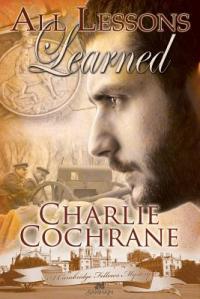
All Lessons LearnedWWI has ended and Dr. Orlando Coppersmith is back at St. Bride’s College, after being freed from a German prisoner of war camp.  The cost of the war is all around him but the deepest, most traumatic blow is the loss of his lover and companion of more than a decade, Dr. Jonty Stewart, killed in action in the Somme.  Orlando is consumed by his loss and going through the motions of his previous life when unexpectedly a case arises to take his mind off his desolation.  A mother is sure her son did not die in battle and wants Orlando to find him or the truth whatever it may be so her mind can be at ease. The pursuit of that truth will take Orlando back to places he wished he could forget and times of untold horror and pain.

But on the French seafront at Cabourg, Lavinia Stewart Broad and her family are taking a walk on the sands when she comes across the last person she ever expected to see, giving her hope and joy for the first time in ages.  The impact of the war that has been left behind on those who fought cannot be lessoned in a day or even month.  And not all the pain and scarring left is visible on the outside.  Nothing in Orlando’s intellectual framework has prepared him for what comes next and it will take everything he has to grasp on to this new hope and hold on through to a future he thought was gone.

From the opening sentence we are audience to a sorrow so profound that you will be weeping within minutes.  I don’t think there is a more powerful symbol of love that can grip you except its absence after having found it and that is Orlando Coppersmith at the beginning of All Lessons Learned.

This is how we find him:

“The twelfth day of the eleventh month, 1918.  Orlando Coppersmith stood outside the prisoner of war camp and listened, almost unbelieving. No distant guns. No shouts or cries. No whinnying of frightened horses. Somewhere a bird was singing—two birds—and a distant dog barked. It felt unreal, as if this were a dream and the memory of the last few years the reality to which they would wake.”

The first world war has ended and its impact is hitting home as the men who survived WWI return back to their lives. Those that don’t return lie dead on foreign soil or have fled, marked as cowards, some because of what we know is PTSD, a concept so foreign that is was mocked as an excuse of cowards instead as the very real condition we know today.  Charlie Cochrane brings the reader the horrors that WWI visited on all involved by making it personal with its impact on characters we have met and come to love in the Cambridge Fellows Mysteries. In the opening pages, we find out that Dr. Peters, the Master of St. Bride’s College has died.  Also gone are Mr. and Mrs. Stewart, Jonty’s parents who also became the same to Orlando over the course of their relationship.  Jonty has been killed during fighting on the Somme and with them everything central to Orlando’s happiness and contentment , the core that made his life worth living is shattered, leaving Orlando adrift, tethered to life by a promise, Mrs. Sheridan nee Peters, and Lavinia Stewart Broad and her family.

I can think of no better way to visit the horrors that war can impart than through the eyes of a beloved character and Cochrane pulls us into Orlando’s memories with a gritty harshness not found elsewhere in the series.  This is a much changed Orlando since last we saw him.  No longer does this vaunted mathematician see the world in black and white.  Time, loss and his experiences on the front and in a prisoner of war camp have changed him forever with one exception.  His love for Jonty is as strong and final as it ever was, and now he is trying to continue living as he promised and falling short.  That changed man, more than anything else Cochrane could have done, tells us how much the world has altered in order for that to happen.  Have the tissues at hand, because this is going to hurt and hurt deeply.

Another fine element of this novel is the subject of what today we know as PTSD and veterans.  Then it had different names, shell shock for one, neurasthenia for another, the last being an ill-defined mental illness that encapsulated everything from fatigue to irritability and mental instability.  That is when it was believed in, for some doctors and the public, it was just an excuse for cowardice under fire. Here is another passage when Orlando is interviewing someone about MacNeil the man he is trying to locate:

“Orlando wouldn’t use the word “desert”. He’d heard too much rubbish spouted about men who’d lost their nerve, especially from people who’d been no nearer the front than the promenade at Dover.”

Those words might just have easily come out of the 60’s, or 80’s or even now.  While the weapons and locations may change, the impact of war upon people’s minds and bodies does not and here we see the results in Orlando and many others he comes across during his investigation.  Through recounted memories or more accurately nightmares, we hear the constant pounding of exploding munitions and the whistling of the shells overhead, the empty sleeves and missing legs of the remnants of the men who made it back, and the holes in the lives left behind of those that didn’t.  This is a grim and necessary element of All Lessons Learned and its impact upon the reader tells you exactly how well Charlie Cochrane did her job in making it real to us too.

There are also some wondrous moments in this story that will make all the pain and tears worthwhile.  They will come not with great shouts of joy and fireworks but quietly, with subtly and that’s as it should be given the nature of the couple at the heart of this series. One of the elements that made Orlando’s grief worse was that he could not mourn the loss of his lover the same as any other “widower” for that was indeed what he was.  Orlando’s grief had to remain hidden from all but a few who knew the couple and their true relationship.  And that isolation of his grief made a deeper cut than if he might have been able to mourn with the countless others at the time.  Orlando Coppersmith is a complex man and brings those same complexities of nature to everything that happens to him, good, bad or miraculous.  So the events that occur later on the story won’t surprise anyone who has become familiar with his character.  Somethings are truly fundamental and that is reassuring too.

This is not the end of the series, although I suspect at the time Charlie Cochrane intended it to be from the epilogue here.  One more book was written.  And that prompted a number of questions I had for the author.  I hope to have my review and the answers to those questions  posted for you sometime soon.  But in a way this does provide a sort of ending because the world and these men were never the same after WWI.  Changes start to happen rapidly throughout the world and the gentler time of the first seven books is forever vanished.   This series has become dear to my heart and we have one more visit to go.  I hope you will stay with me to the end.  For those of you for whom this review is your first introduction, please start from the beginning.  Take your time getting to know these remarkable men, delve into life and times of England in the 1900’s.  It starts out with all the joys of a slow promenade and then picks up the pace with each succeeding book.

It is an extraordinary journey. Dont miss a page of it.  Here are the order the stories were written and should be read to fully understand the relationships and events that occur:
Lessons in Love (Cambridge Fellows, #1)

Lessons in Desire (Cambridge Fellows, #2)

Lessons in Discovery (Cambridge Fellows, #3)

Lessons in Power (Cambridge Fellows, #4)

My True Love Sent To Me

Lessons in Temptation (Cambridge Fellows, #5)

Lessons in Seduction (Cambridge Fellows, #6)

Lessons in Trust (Cambridge Fellows, #7)

Once We Won Matches (Cambridge Fellows, #7.5)

All Lessons Learned (Cambridge Fellows, #8)

Lessons for Survivors (Cambridge Fellows, #9) – released by Cheyenne Publishing.

For free stories in the Cambridge Fellows Mysteries universe and more about the author, visit the author’s website.


Rushed Dental Work, a Delay In Today’s Review and the Franco-British Exhibition of 1908

So, yeah, here I am about to head off for some rushed dentistry, a root canal that had to be done asap and I am not happy or feeling great at this moment.  But I won’t rush the review of Lessons in Trust by Charlie Cochrane, so there will be a slight delay in posting.   I will say that I loved this book and it sent me into paroxysms of  delight when researching the 1908 Franco British Exhibition which Orlando and Jonty attend.

See, this is one of my anticipated joys of Charlie Cochrane’s writing, she always includes  some wonderful tidbit of information or history I didn’t know about, educating me just enough to make me want to know more.  I mean really, how could you resist a 1908 ride with the name The Flip-Flap?

Here is a postcard view of the White City, the location (on 120 acres) of the Franco-British Exhibition in west London.  It was called The White City because all the exhibition buildings were  painted white. There were “villages” of various nationalities people could visit, like an Irish Village, a Senegalese Village,  Think of it like the Las Vegas strip of its day with the Luxor Pyramid, Eiffel Tower , well, you get the drift.    Here is a central view:

Franco-British_Exhibition

Then there is the marvel called The Flip-Flap ride.  Orlando, Jonty, and Mr. Stewart could get enough of this ride,  Think of the most popular rides at Busch Gardens or Six Flags, and they would not come close to the popularity and awe that was The Flip Flap .  It’s outline dominated the skyline.  Here is a post card of the ride, wouldn’t you just love for a chance to climb on?

Postcard of the Flip-Flap ride

And finally,  the age of the automobile has arrived and Jonty is full of enthusiasm for this new form of transportation.  Jonty has bought a Lagonda and loves it dearly, an affection Orlando doesn’t share.  So of course I wanted to know more about what the car looked like that drove Jonty to such heights of prose and poetry.  Off to research some more.  And I found out that the  Lagonda cars were invented by an American named Wilbur Gunn.  Wilber had two passions in life, singing and engineering and it was as an opera singer that he came to Britain.  But once there he started crafting things from fast boats to motorcycles.  In 1904 he progressed from 3 wheeled vehicles to motor cars of which  74 original models were made.  Of course, Jonty would have one of them.  The name Lagonda?  That is Shawnee for Bucks County in Ohio where Wilbur Gunn was from.  It is also the name of his father’s company, the Lagonda Corporation which made tube  cleaning machinery.  I was unable to find any photos of the model Jonty would have had but here is a  photo of a 1928 Lagonda.  So sporty and elegant I would dearly love to have one as well:

Lagonda 1928 lag 3 litre

So I hope this will give you a taste of what is to come in my review of  Lessons in Trust. Keep these images in mind when I am relating parts of the story.  It is a marvelous book so I hope you won’t mind the wait.  See you here a little later on, sore jaw not withstanding.

Dreaming of Spring while Singing the Flues Blues and the Week Ahead in Reviews

Maryland seems to have dodged another major “storm of the century” that is still leaving its impact on New England and the NE corridor from Philly to Maine is coated with the white stuff.  While those unfortunate fellows are digging out from under several feet of snow, we had to deal with wind and rain and little else.

Unless you count the flu.   Yes, that’s right, the flu. Or maybe you have the norovirus, that’s going around too.  Either way, like myself, you are probably feeling less than stellar.  I did gather all the right stuff around me as the symptoms hit. Hot tea? Check.  Loads of tissue? Check.  Blankets to huddle under?  Check. Every over the counter cold drug you could buy? Check. Reading material and knitting projects? Check.  So what is missing?  My ability to focus and stay awake.  I have no energy.  Sigh.  So while I have a schedule for this week, it might be touch and go to stay by it.  Let’s see what happens in between doctors appointments, shall we?

Here are the reviews planned:

Monday, Feb. 11:              Lessons in Seduction by Charlie Cochrane

Tuesday, Feb. 12:             Feeling His Steel by Brynn Paulin

Wed,, Feb. 13:                   Brothers in Arms by Kendall McKenna

Thurs., Feb. 14:                 Superpowered Love: Losing Better by Katey Hawthorne

Friday, Feb. 15:                 The God Hunters by Mark Reed

Saturday, Feb. 16:             Reader Questions.  If you could talk to an author, what would you ask them?

Meanwhile here is a vid making the rounds that cheered me up.  Love the reaction of the older sister.  These kids rock.

Review: Promises Made Under Fire by Charlie Cochrane

Rating: 4.5 stars

Promises Made Under FireIt’s France, 1915, and Europe has been fighting WWI for a year.  Lieutenant Tom Donald and his fellow officer Frank Foden help alleviate both the tedium and the terror by sharing confidences about their family and friends back home.  Frank Foden, a confident popular officer with a positive outlook on life, happily shares his letters from home with Tom, including those from his physician wife, a rarity at that time.  Letter after letter, arriving sometimes twice a week, enliven their day. Frank and Tom laugh about her “doctor’s scribble” of handwriting and her accounts from home, and soon Tom begins to feel that he knows her as well as Frank.  The one thing he doesn’t share with Frank is the knowledge that Tom prefers men to women,  a fact that would see him booted from the army and most likely imprisoned.

Then Frank is killed on the front and Tom injured.  Tom is sent home to recover and act on a last request from Frank.  Frank left several letters for Tom to deliver in person.  One to Frank’s mother, and one to a man named Palmer who Tom has never heard Frank mention.  Tom’s journey to fulfill his mission will uncover some starting facts about Frank, and his life back home, starting with the fact that everything he knew about the man was a lie.

Promises Made Under Fire is just another fine example of historic fiction from author Charlie Cochrane.  Cochrane returns us to the front.  It is WWI and England has been fighting for a year. We are given Englishmen under incredible stress and facing imminent death every moment they are in the trenches and yet touches of civilized society still order the soldier’s day, including their officer’s servant who serves them tea and acts as “nursemaid and housekeeper” to both Tom and Frank, a decidedly English detail.  And because this is Charlie Cochrane, you can count on the historic details she presents during the story as being accurate as well as interesting.  I have always admired the manner in which Cochrane folds her  historical facets into her story while bringing it all effortlessly to life in front of us.  I could hear the sounds of guns nearby and smell the powder on the air but the main focus is always on her characters.

What amazing characters are laid out before us.  Cochrane has a remarkable ear for dialog and her character’s “language” is true for each person and their social status.  Here is Bentham, their officers servant, talking about the Jerry’s(Germans):

“He’s probably plotting even when he’s kicking up Bob’s a dying.” (Bentham)

“Bob’s a dying?” (Tom)

“Dancing and frolicking, sir.”

In just those few sentences, you understand immediately that Bentham is lower class, given his colloquialisms, and that Tom is decidedly upper class, given his  lack of understanding about the same.  Loads of backstory in a few simple phrases, just perfection.

In fact, without realizing it, the reader is absorbing tons of information about the men in the story without having it spelled out for us just through the dialog alone.  The front and it’s horrors are quite real as is its impact upon our main characters.  In fact there is not one element here that isn’t brought fully to life.  This story and its characters, live, react, and painfully try to recover from the devastation the war has wrought  upon them and their world.

I love how this story slowly unfolds, giving us time to know and care about Tom and Frank, and Tom’s journey home is a revelation in more than one way.  The use of letters is a  form of narrative that always charms me and it is used to perfection here to move the story forward. But you never forget that this is a love story, and that love between men is something to be carefully hidden and protected.  Discretion is the rule these men live by and the lengths they must go to in order to protect the ones they loved.

This is an absolutely marvelous love story but the end is in keeping with the times and perfectly realistic for the men involved.  The more I thought about it the more I appreciated the manner in which Cochrane remained true to her characters, and her period.  And leaves us with the possibility of more should she ever wish to return to Tom and see how he is getting on.  Put a pot of tea on, place some biscuits on a plate and settle down with Promises Made Under Fire to return to war torn England and a love that dares not speak its name.

17,000 words

cover artist is unknown which is a shame considering how perfect this cover is for the story.  Lovely in its detail and design.

Review: Trick of Time by J.L. Merrow

Rating: 5 stars

Trick of Time coverDevastated and scarred from the car accident that killed his husband and parents,  Ted Ennis decides to  work as a theatre assistant at the Criterion Theatre for his friend Rob,the manager of the theatre, rather than return to the bankers job he held prior to the accident and his disability. The crash has left Ted with some permanent physical issues as well as emotional ones, his hand shakes and his voice and speech changes under duress.  When stressed, one the of the things that helps to calm Ted is smoking.  One night during a production at the Criterion Theatre, Ted slips out the backdoor to grab a smoke and steps back in time into Victorian London.

With its dim lamps for street lights and sooty air, the sights and sounds of a 1800’s London surrounds him and Ted starts to wonder if the accident had not caused more damage to his brain than had been acknowledged.  Then amidst the horse carriages and people rushing by Piccadiily Square, Ted sees a beautiful young man leaning nonchalantly against a lamppost whose very face beckons Ted away from the theatre doorway.  The lad’s name is Jem and he’s a local whore who has mistaken Ted for competition.  At first, their relationship is a monetary one, but it quickly turns into something neither man is quick to label, drawing Ted back in time again and again searching out Jem just to be with him. But Ted doesn’t understand how or why he can travel back in time, and each time he returns, Jem is getting thinner.  Something tells Ted that time may be running out for them both unless he can figure out the trick of time.

J.L. Merrow has pulled from one of the most romantic, haunting of themes for the central basis of this story – that of opening a doorway or portal and stepping back in time.  Whether it is a door to a wardrobe,the sash of a window,or an unlikely looking machine,  the idea of actually being able to visit the past has enthralled and enchanted many a author and reader.  A Trick of Time, J.L. Merrow’s marvelous take on this theme, gives us a romantic, haunting and satisfying addition to this genre.

I am always so appreciative of Merrow’s ability to bring history to life through the author’s books and tales.  Within Merrow’s stories, the reader is thrust back in time where the air with thick with coal dust, the streets dingy, and life perilous for those poor or gay or just unlucky.  Here is a sample.  Ted and Jem have just sat down at a lowly pub near the theatre .” I looked down at the table, its surface scarred and pitted with use, crumbs of long-digested meals wedged in its crevices.”  I felt as though I could see that table, smell that table with its remnants of old food and greasy stench wafting up from its scarred wooden surface.  Merrow brings that pub to life in vivid detail, and does the same for every other part of this story.  I felt as though I had walked the streets accumulating grime as I strolled.

But it is her characters that bring the magic to the story.  Ted is a haunting and haunted figure with his scarred head, shaking hands, and survivor’s guilt.  How he grabs our empathy from the start and keeps it close throughout the story. We feel his disbelief when he steps into the past, and his terror that it might be his sanity at error. And as Ted’s desperation to see Jem, to be with Jem grows, we feel it as well.  And always in the back of our minds and Ted’s, is the fear that the doorway will close and Jem will be lost.  Merrow skillfully balances the deepening relationship with the growing fear of loss of same and keeps us teetering on the edge, caught between happiness and horror, joy and pain for Ted and Jem.  And make no mistake Jem is as beautifully realized a character as Ted Ennis.  Cocky, beautiful and very much a survivor but for how long?

Yes, there are places where some will argue that you have to suspend your belief, but don’t you have to do that to accept time travel as a possibility? This is a story of magical possibilities, a visitation to those dreams held close to the heart, of a love that not even time can deny to one who hopes. And who can deny the enchanting miracle of that?  Not me.  I loved this story and I think you will find it magical too.

Lovely cover although credit is not given to the artist in the book.

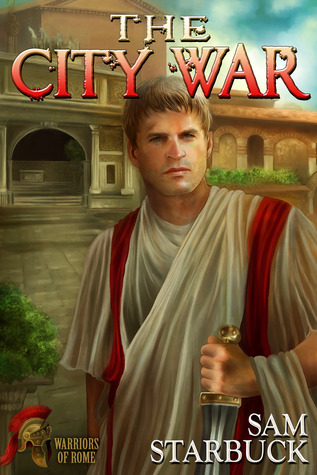
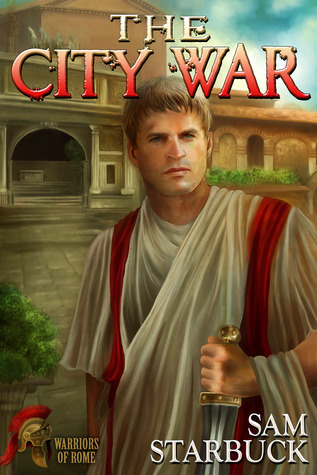
Review: The City War by Sam Starbuck

Rating: 4.25 stars

Senator Marcus Brutus is finding it perilous times to be a Senator in Rome, especially one not lined up behind Caesar.  Caesar is making moves to get rid of the Republic and crown himself Emperor of Rome and that is something Marcus Brutus just  cannot abide.  Brutus has devoted his life as has his family to the Republic of Rome and to see it demolished under Caesar sickens him. When he retreats to his country estate with his brother-in-law and lover, Cassius, he knows that there are hard decisions to be made and soon if the Republic is to be saved.

Cassius has pulled his long time lover, Marcus, out of Rome for a purpose. There is a mutiny brewing in Rome and he is part of it.  Even his sister agrees that something must be done about Caesar and soon if the Republic is to survive.  Now to make Marcus Brutus understand how necessary is the course of action Cassius and others have planned, as well as the major role Brutus is to play. And he hopes their love is strong enough to survive what he intends to throw before it.

Tiresias claims to be an orphaned boy when he meets Brutus on the road to his country estate.  But looks can be deceiving especially when the boy looks as delectable as Tiresias.  Tiersias appears before Brutus on a gorgeous animal and states that all the horses that Brutus owns should look as good.  And of course, Marcus Brutus is hooked, hiring the young man and sending him on ahead to the estate.  In one move, Brutus has captured Tiresias’ heart and loyalty as Tiresias has captured his.

All three men will face the toughest decisions of their lives as Caesar’s ambitions start to cause even the sanest of Senators to think the unthinkable. Cassius will ask everything of the man he has loved since childhood.  Tiresias will follow Marcus Brutus back to Rome and perhaps his death.  And Marcus Brutus?  He faces the loss of everything he loves. The Republic of Rome, his lover Cassius, the young boy who idolizes him and even the man who protected him when others would have put him to death – Caesar himself.

If you love history, especially the era of ancient Rome, this is the book for you.  Sam Starbuck takes a well known historical fact, the assassination of Caesar and the well known “Et tu, Brutus?” and makes it all so relatable as well as the human actions that set it in motion.  This is the assassination as seen from Marcus Brutus’ anguished perspective and a needed reminder that there are always more than one way to look at history.  Sam Starbuck has done, as he relates in his blog, his research and it certainly shows.  He makes Rome and its countryside come alive again as well as the incidents some might know only from the dusty tomes of history.

Into the tale of deceit and conspiracy, Starbuck weaves the story of the romance between Cassius and Brutus, a long established affair that is even given support by their wives.  This is really not a far fetched idea as a well known quote about Caesar (from one of his many enemies) was that Caesar was a “husband to every wife and a wife to  every husband”, which meant that Caesar himself entertained men as well as women sexually.  Here homosexuality had not yet been demonized by Christianity and the taking of male lovers was almost a given, albeit with some strict behavioral guidelines.  And this includes the mentor/young man sexual relationship which is mentioned here with regard to two couples.  The first is Aristus, former tutor and publican, now old friend of Marcus Brutus the younger.  They have an established sexual relationship in which Aristus mentored  Brutus in the ways of homosexual love, which ended when Brutus was no longer his student (in every respect).  The second  relationship of a similar manner is that between Marcus Brutus and Tierisias. While certainly a deeper relationship emotionally, at least on Tiresias’ side, it is still in keeping with the older man benefactor/young student or recipient bond.  I never felt that their connection was deeper than that, at least on Brustus’ part.

And really that is the heart of my quibbles with this wonderful in every other respect story.  I loved The City War as an intimate look into the events leading up to the assassination of Caesar from the POV of the main conspirator.  But as a m/m romance, that is a much harder sell.  The long standing sexual affair between Cassius and Brutus has all the elements of two men who know each other intimately inside and out.  They have been through war campaigns together and lasted through their marriages, even to the sister of one of them. So I kept waiting to feel a equally intimate connection between them, one born of romantic love and not that of brothers in arms.  And I never felt it.  Or bought into it.  And I think that is perhaps far more realistic a take on their relationship than that of two men deeply in love with one another.

And that carries over to the relationship between Brutus and Tiresias. That is a relationship of unequals, as it has to be.  Roman society as well as Roman thought would not allow it to be anything else.  There is an equally surprising factor about Tiresias that I felt the author handled beautifully and with great respect.  This was so well done that I want to give Sam Starbuck a little extra kudos for the character and Tiresias’ back history.  Really, Tiresias is one of the most interesting characters you will meet between these pages.  Really, he is a lovely surprise that gives this already fascinating story a added dimension.

At 123 pages, The City War is a quick yet well researched look into one of history’s most infamous moments.  I thought Sam Starbuck did a wonderful job here and look forward to his next story.  This is part of the Warriors of Rome series from Riptide Publishing.  So if history, gladiators, Rome and everything in between is your thing, run out and pick this one up.  Continue on to the rest of the series and settle down for a great trip back in time to the golden age of Rome.

Guest Post by Sam Starbuck and Contest for The City War Blog Tour

Scattered Thoughts and Rogue Words is happy to have Sam Starbuck here to blog about his latest book, The City War, published by Riptide Publishing:

Hello everyone! I’m pleased to be hosted by Scattered Thoughts today as part of a blog tour for  The City War, my first novella to be released with Riptide Press.

This is the second part in a series of posts I’m doing about the process of writing historical romantic fiction, and how one gets from being a history nerd to a romance writer in a few easy steps; today’s entry is about the delicate dance of historical fiction. To thank you all for reading, I’m offering a chance to win $10 in credit with Riptide Publishing; every comment you leave on the post today and for the entire tour enters you to win!

Something that comes up frequently when people talk about writing historical fiction of any subset is the difficulty of Getting Everything Right. If you set a story in ancient Roman culture — as the Warriors of Rome series is — it’s easy to leave out things we’re aware don’t belong: microwaves, cellphones, pianos. It’s often harder to leave out things we don’t know don’t belong — did the ancient Romans have books, or only scrolls? Did they have plates and cups? Did they have toilet paper? (Yes, Yes, and No.)

It’s daunting, the idea of having to know a dead culture so well that you can create a whole world without screwing it up.

But it’s also fun.

One of the things I researched for The City War was the food served at feasts, particularly feasts for the nobility of the highly class-stratified culture of Rome. 

The servants brought in trays of apricots in sweet sauce and lentils imported from Egypt, roasted thrushes, goose livers in garum and oysters in cumin sauce.

“The servants brought in trays of apricots in sweet sauce and lentils imported from Egypt, roasted thrushes, goose livers in garum and oysters in cumin sauce. Cassius occasionally licked sweet apricot sauce off his thumb, glancing at Brutus with lowered eyelids to see if he noticed. Brutus saw that Aristus did, and the older man drank more wine than usual. Brutus just busied himself counteracting the heat of the cumin with bites of honey-soaked melon, and ignored them both as children. He was getting tired of Cassius’s air of mystery.

By the time the servants brought in the pig—small but well-cooked, and stuffed with tender laurices and fragrant spices—Brutus saw the horse-boy watching the dancers as well, crouched in a shadow behind a tall window that let the breeze pass from the outer yard into the triclinium.”

It sounds delicious and poetic, but sometimes that’s part of the trick of historical fiction; goose livers in garum seems luxurious, if slightly gross to our modern sensibilities, until you find out that garum is a sauce made from fish that’s been left to decay in the sun for days. “Stuffed with tender laurices” makes the mouth water — until you look it up, as one of my editors did, and realize that a laurice is the term for the unborn fetus of a rabbit, a delicacy in ancient Rome. But part of the joy of writing for this era in particular is the fierceness and the nearness to the food chain that even the upper classes were required by their limited technological means to engage in. It was an earthy time.

Historical fiction is about getting the world right, but also getting the sense of the world right. It’s important to understand the spirit of an era — and sometimes to temper it a little in places, particularly when writing romance, which I’m also addressing today over at  Well Read.

Bio: Sam Starbuck is a novelist and blogger living in Chicago because he enjoys trains, snow, and political scandals. By day, he manages operations for a research department at a large not-for-profit, and by night he is a pop-culture commentator, experimental cook, advocate for philanthropy, and writer of fiction. He holds two degrees in theatre, which haven’t done much for his career but were fun while they lasted. His love of ancient cultures and art crimes makes him a very strange conversationalist at parties. His novels include Nameless, Charitable Getting, and Trace, published independently, and The City War, published with Riptide Publishing. He blogs here, and you can check out his writerly accomplishments here.

The City War 

Blurb: Senator Marcus Brutus has spent his life serving Rome, but it’s difficult to be a patriot when the Republic, barely recovered from a civil war, is under threat by its own leader. Brutus’s one retreat is his country home, where he steals a few precious days now and then with Cassius, his brother-in-law and fellow soldier—and the one he loves above all others. But the sickness at the heart of Rome is spreading, and even Brutus’s nights with Cassius can’t erase the knowledge that Gaius Julius Caesar is slowly becoming a tyrant.

Cassius fears both Caesar’s intentions and Brutus’s interest in Tiresias, the villa’s newest servant. Tiresias claims to be the orphaned son of a minor noble, but his secrets run deeper, and only Brutus knows them all. Cassius, intent on protecting the Republic and his claim to Brutus, proposes a dangerous conspiracy to assassinate Caesar. After all, if Brutus—loved and respected by all—supports it, it’s not murder, just politics.

Now Brutus must return to Rome and choose: not only between Cassius and Tiresias, but between preserving the fragile status quo of Rome and killing a man who would be emperor.

You can buy The City War or read an excerpt here at Riptide Publishing.

Thank was wonderful.  My review of The City War will be posted tomorrow and you won’t want to miss it. And don’t forget to enter your name in the contest.  Just leave a comment and you are entered into the contest to win $10 in credit at Riptide Publishing. The Winner of the contest will be announced at the end of the tour.

Good luck, everyone.  And my thanks to Sam Starbuck and Riptide Publishing for stopping by today.

Review of A Mutual Understanding by Caro Soles

Rating: 3.25 stars

It is 1984.  Wayne Robinson, hair dresser and sometime artist,  surprisingly has always been an out gay man, even flamboyantly so given the small college town he lives in.  He is surrounded by the people he has  known all his life and his family lives nearby.  After dumping his ex for sleeping around, he sees Professor Adrian Taylor and  immediately falls into instant lust and then love. Wayne starts pursuing the man until he “catches” him.  But Wayne feels insecure and undereducated in Dr. Taylor’s presence.  And the man gives Wayne mixed signals whenever they are together, so much so that Wayne is confused as to what Adrian really wants from him.

Dr. Adrian Tayl0r is in the closet as a professor at the local college and the courtship of the gorgeous young hairdresser has turned his tightly controlled, neat lifestyle upside down.  When Adrian buys an huge old Victorian house in town to fix up, live in and rent out rooms,he invites young campy Wayne to move in with him.  But neither man is good with communicating with each other, and misunderstandings quickly arise over what each man expects from the other when living under the same roof.  Then a close friend of Wayne’s falls ill with AIDS and fear rocks the town.  Can both men come to a mutual understanding before they lose their chance at a relationship?

A Mutual Understanding had the potential to become a wonderful, realistic look at a small town’s reaction to gays and the AIDS epidemic in the 80’s, but that promise was never fulfilled as the story lingered over a miscast romance between main characters who never captured my attention or affection.  I did love Wayne Robinson, the campy and out young hairdresser with the big heart.  The descriptions of Wayne  taking his mother on her visit’s to her friends on Sunday were perfect.  I could see the whole thing unfold before me as though I was in the room with “Auntie Marge”, her mother Flo and the old dog outside on the porch.  I only wish the affection, care,  and authenticity the author took in creating these scenes carried throughout the book.  You understood these people immediately as small town USA is populated with them. In fact the book is full of easily recognizable small town characters, from the owner of the hair parlor where Wayne works to the people at the diner. So it feels right when the town “seemingly” accepts Wayne’s homosexuality as he is one of theirs until another gay man in town comes down with AIDS and the acceptance is seen for the fragile thing it really is as fear and ignorance takes over.  But again given the time period, the actions of the townspeople are in keeping with the time period and the AIDS timeline.

Outside of the “romance”,  Wayne acts in an appropriately realistic manner.  He comforts his friend who has AIDS, he rescues those in need, he supports his itinerant younger brother until he realizes the extent his brother has taken advantage of him.  I love the portrait the author paints of Wayne’s family  and their interaction with their son as well as his friends, again another terrific element here.

So what is the problem with this book?  That would be the character of Dr. Adrian Taylor and the romance between the two main characters.  There is nothing remotely attractive about this man so his appeal to Wayne is never understood, especially in light of his treatment of Wayne throughout the novel.  Yes,  Dr. Taylor is in the closet so Wayne’s appearance at his office time after time poses a threat to his closeted life.  I do get that. But this is a rigid, closed off man who thinks very highly of himself.  The author has him saying to Wayne “Oh, I see you have been reading again” repeatedly after Wayne has used a more erudite word or phrase.  Are we supposed to find this constant disparagement adorable?  Why are we supposed to like this pompous,  priggish man and think him a welcome companion to a very endearing young man?  I just could never see it nor could I understand the author’s fondness for this character.  It never made any sense, and therefore I never bought into their love story.  When you can’t sell the love affair in a romance book, you know the author is in trouble.

Another thing that didn’t make sense was having a man in his  early forties acting as though he was much older, antiquated mannerisms to go with the antiques he collected.  Even in the 80’s, being in your forties was not considered old.  Acting in a frigid manner in your forties yes, acting as though you were frozen in the 1800’s? No.  Dr. Adrian Taylor is perhaps the only character who came across as flattened cardboard cutout and that ruined any potential for the romance aspect of this book.

This is the first book I have read by Caro Soles and I try never to judge an author based solely on one novel.  So I look forward to reading more of this author to see if the potential I see here is reflected elsewhere in her stories.  Again, had the character of Dr. Taylor been removed and the story concentrated on Wayne and his friend with AIDS I think this review would have been totally different.  But I would give A Mutual Understanding a pass when you are choosing your next book to read.

Cover: Deana Jamroz is the cover artist. Dr. Adrian Taylor does not fit the man in the background who seems too young for his description.

Review of Brook Street: Thief by Ava March

Rating: 4 stars

Lord Benjamin Parker has always thought that he might be gay but never put it to a test.  Until now.  One evening at a gambling hell known to be frequented by men who discretely prefer the company of other men, he sits at a card table next to one of the most attractive men he has ever seen.  That man turns out to be Cavin Fox. Cavin Fox has come, not to gamble, but to pick up a wealthy mark to take home and fleece, leaving the mark’s pockets empty come morn.  But he is enjoying their flirting and conversation and the even drags on more than it should.

When the men do leave the establishment together, the night turns into a evening of sexual exploration that neither man will forget.  And Cavin leaves, taking nothing from Benjamin as being with Benjamin has affected him deeply.  Benjamin feels the same and wants nothing more than to see Cavin again.  When events conspire to bring them together  again, Benjamin vows to keep Cavin with him just as much as Cavin feels he cannot stay and take advantage of Benjamin’s feelings.  It takes a dramatic rescue and confrontation to bring about a solution they both can accept in order for a thief and a lord to live happily ever after.

Brook Street: Thief is the first of a trilogy by Ava March that captures the historical feel of the times and still delivers an emotionally rewarding romantic story of love found among the gutters.  Both main characters are easy to love.  Lord Benjamin comes across as an affable fellow, good natured, and generous hearted.  His story of how he determines he actually may be gay will bring smiles to your face as it did to Cavin’s.  The youngest of five children of a Marquis, he doesn’t stand to inherit the title or lands so he is free to be a “confirmed bachelor” all his life, a quaint way of saying he prefers the company of men.  But it is with Cavin Fox that my sympathy and love were quickly seated.  A guttersnipe who was plucked out of the streets by a man named Hale who prostituted him out as well as trained him to be a thief, Cavin still retains a gentle soul and good heart.  When in his anquish he determines not to see Benjamin again, the reader hurts as badly as he does.  Ava March does such a terrific job with them both, that I never felt they were anything less than real.  A young man named Sam also figures into the story as a young brother figure for Cavin.  I hope to see more of him  in the latter stories.

And there is the setting here.  It is 1822, London, England.  March’s descriptions of the hellish nature of the place where Hale, Cavin and the boys live gave me the shivers.  From her vivid descriptions, I could see the rats and urchins vying for garbage scraps as the consumptive whores with their dirty feet watched from their doorways.  Never was I go glad to be living in 2012 America.  March did a beautiful job of conveying time, place and atmosphere and all in a mere 112 pages.  Quite a feat.

If I have a quibble it is that the ending came about a little too fast and the solution Benjamin and Cavin found seemed too pat an answer for the times they live in.  But considering the happy ending and the promise of more to come, I will leave my quibbling there.  I look forward to reading the rest of the trilogy.

Cover.  What a gorgeous cover! Stunning in its emotional appeal and  coloring.  Fantastic job.